Akkemik, Küçük Ali

Loading...
Profile Picture
Name Variants
Akkemik, Küçük Ali
K.,Akkemik
K. A. Akkemik
Küçük Ali, Akkemik
Akkemik, Kucuk Ali
K.,Akkemik
K. A. Akkemik
Kucuk Ali, Akkemik
Akkemik, K. Ali
Akkemik, K.A.
Akkemik,K.A.
Akkemik, Ali
Akkemik, K. Ali
Job Title
Doç. Dr.
Email Address
Alı.akkemı[email protected]
Main Affiliation
Economics
Status
Former Staff
Website
ORCID ID
Scopus Author ID
Turkish CoHE Profile ID
Google Scholar ID
WoS Researcher ID

Sustainable Development Goals

15

LIFE ON LAND
LIFE ON LAND Logo

0

Research Products

16

PEACE, JUSTICE AND STRONG INSTITUTIONS
PEACE, JUSTICE AND STRONG INSTITUTIONS Logo

0

Research Products

14

LIFE BELOW WATER
LIFE BELOW WATER Logo

0

Research Products

6

CLEAN WATER AND SANITATION
CLEAN WATER AND SANITATION Logo

0

Research Products

3

GOOD HEALTH AND WELL-BEING
GOOD HEALTH AND WELL-BEING Logo

0

Research Products

17

PARTNERSHIPS FOR THE GOALS
PARTNERSHIPS FOR THE GOALS Logo

1

Research Products

4

QUALITY EDUCATION
QUALITY EDUCATION Logo

0

Research Products

2

ZERO HUNGER
ZERO HUNGER Logo

0

Research Products

10

REDUCED INEQUALITIES
REDUCED INEQUALITIES Logo

1

Research Products

7

AFFORDABLE AND CLEAN ENERGY
AFFORDABLE AND CLEAN ENERGY Logo

1

Research Products

13

CLIMATE ACTION
CLIMATE ACTION Logo

0

Research Products

1

NO POVERTY
NO POVERTY Logo

0

Research Products

9

INDUSTRY, INNOVATION AND INFRASTRUCTURE
INDUSTRY, INNOVATION AND INFRASTRUCTURE Logo

1

Research Products

12

RESPONSIBLE CONSUMPTION AND PRODUCTION
RESPONSIBLE CONSUMPTION AND PRODUCTION Logo

1

Research Products

8

DECENT WORK AND ECONOMIC GROWTH
DECENT WORK AND ECONOMIC GROWTH Logo

6

Research Products

11

SUSTAINABLE CITIES AND COMMUNITIES
SUSTAINABLE CITIES AND COMMUNITIES Logo

1

Research Products

5

GENDER EQUALITY
GENDER EQUALITY Logo

0

Research Products
This researcher does not have a Scopus ID.
This researcher does not have a WoS ID.
Scholarly Output

22

Articles

13

Views / Downloads

117/3903

Supervised MSc Theses

3

Supervised PhD Theses

1

WoS Citation Count

298

Scopus Citation Count

343

WoS h-index

7

Scopus h-index

8

Patents

0

Projects

0

WoS Citations per Publication

13.55

Scopus Citations per Publication

15.59

Open Access Source

14

Supervised Theses

4

Google Analytics Visitor Traffic

JournalCount
Applied Energy1
Energy Economics1
European Journal of Operational Research1
Journal for the Study of Religions and Ideologies1
Journal of Behavioral and Experimental Finance1
Current Page: 1 / 3

Scopus Quartile Distribution

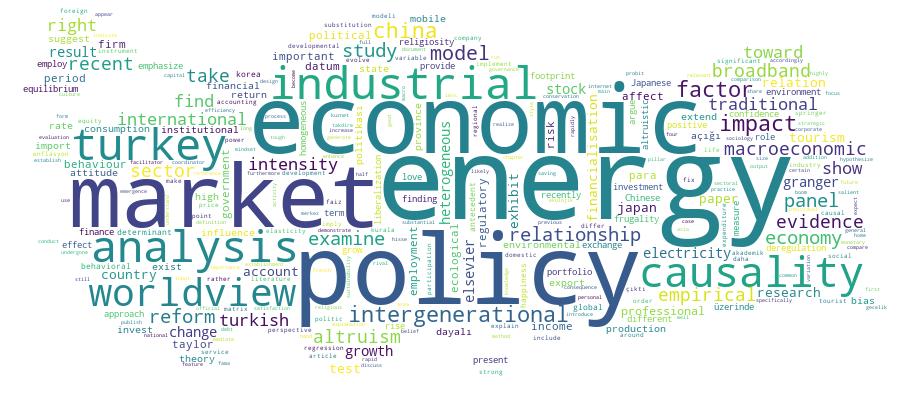
Competency Cloud

GCRIS Competency Cloud

Scholarly Output Search Results

Now showing 1 - 10 of 22
  • Article
    Citation - WoS: 97
    Citation - Scopus: 96
    Macroeconomic and Institutional Determinants of Financialisation of Non-Financial Firms: Case Study of Turkey
    (Oxford University Press, 2014) Akkemik, K. Ali; Özen, Şükrü
    We observe that industrial firms in Turkey have shifted substantial amounts of working capital from production activities to the purchase of high-yield interest-bearing assets most notably public bonds to ensure immediate short-term interest revenues. Introducing the new and historical institutional literatures to the financialisation research this article empirically examines the influences of macroeconomic and institutional factors on non-financial firms' financialisation behaviour for the period 1990-2002. The findings from panel regression analyses using data from 41 firms listed on the Istanbul Stock Exchange indicate that both macroeconomic and institutional factors influence financialisation behaviour to different degrees. Turkish non-financial firms particularly engage in financialisation as a response to highly uncertain macroeconomic conditions. The findings indicate that the key characteristics of state-organised business system in Turkey such as firms' ties with the government and family ownership are not conducive to financialisation behaviour.
  • Book Part
    Citation - WoS: 3
    Citation - Scopus: 2
    Dependence on Imported Inputs and Implications for Technology Transfer in Turkey
    (Springer New York, 2012) Akkemik, K. Ali
    Trade and macroeconomic policies in Turkey evolved from import substitution to export promotion and liberalization of commodity and capital markets after 1980. During the 1980s and 1990s Turkey’s exports and imports and their shares in GDP demonstrated an increasing trend. The share of exports in GDP increased from 4.2% in 1980 to 20.3% in 2005 and that of imports rose from 11.4 to 32.2%. Import liberalization was accomplished during the second half of the 1990s and at around the same time direct price support for exports was abolished. © Springer Science+Business Media LLC 2012. All rights reserved.
  • Article
    Citation - WoS: 57
    Citation - Scopus: 65
    Energy Consumption-Gdp Nexus: Heterogeneous Panel Causality Analysis
    (Elsevier Science Bv, 2012) Akkemik, K. Ali; Göksal, Koray
    Existing studies examining the Granger causality relationship between energy consumption and GDP use a panel of countries but implicitly assume that the panels are homogeneous. This paper extends the Granger causality relationship between energy consumption and GDP by taking into account panel heterogeneity. For this purpose we use a large panel of 79 countries for the period 1980-2007. Specifically we examine four different causal relationships: homogeneous non-causality homogeneous causality heterogeneous non-causality and heterogeneous causality. The results show that roughly seven-tenths of the countries exhibit bi-directional Granger causality two-tenths exhibit no Granger causality and one-tenths exhibit unidirectional Granger causality. (C) 2012 Elsevier B.V. All rights reserved.
  • Master Thesis
    The Effects of Common Macroeconomics Factors on U.s Stock Returns
    (Kadir Has Üniversitesi, 2014) Şengül, Serkan; Akkemik, Ali
    In this study, the macro variables' explanatory power in relation to the variation of stock returns has been discussed in terms of the economy of the USA. In order to make an analysis on the cross section of the stock returns, 131 Macroeconomic variables between 1964 and 2007 have been put into use. Summing up the information in 131 monthly series, dynamic factor analysis is used to take out 8 potential factors. So that the pragmatic presentation of the factor model can be measured, Fama-Macbeth's test procedure of two phases is applied. In addition to the variables included in the literature such as market risk factor, size factor, value factor and momentum factors, it is found out that the macro factors are highly influential on the explanation of the common variation in U.S stock returns. The tests stated above have been performed by the means of Fama French 49 industry portfolios, apart from Fama French 100 portfolios that have been formed on size and book. Furthermore, the factor model is established and intended for the certain periods of boom and recession. In comparison to the boom periods, the relations established between latent factors and stock returns appear to be unimportant during the downturn periods.
  • Article
    Citation - WoS: 55
    Citation - Scopus: 79
    Assessing the Importance of International Tourism for the Turkish Economy: a Social Accounting Matrix Analysis
    (Elsevier Science, 2012) Akkemik, K. Ali; Akkemik, K. Ali
    The international tourism sector has grown rapidly in Turkey since the 1980s and Turkey ranks among the top ten countries in terms of tourist arrivals and receipts. Previous studies on international tourism in Turkey are partial equilibrium studies which emphasized the importance of the sector for foreign exchange earnings employment creation and economic growth. The social accounting matrix (SAM) modeling approach is superior to partial equilibrium analysis as it takes into account intersectoral linkages. This paper analyzes the contribution of international tourism to the Turkish economy using two SAMs for 1996 and 2002 respectively. Two analyses are conducted using the SAM impact model: (i) sectoral comparison of GDP elasticities and (ii) SAM impact analysis of international tourism on output value-added and employment. The results show that the GDP elasticity of international tourism is relatively low and the impact of foreign tourist expenditures on domestic production value-added (GDP) and employment in Turkey are modest. The results imply the possibility of leakage of foreign tourist expenditures out of the economy. (C) 2011 Elsevier Ltd. All rights reserved.
  • Master Thesis
    Taylor Modelinin Türkiye'ye Uygulanması
    (Kadir Has Üniversitesi, 2013) Çimenser, Serdar Can; Akkemik, K. Ali
    Önemi ekonomiler üzerinde her geçen dönem artan Merkez Bankaları ve uyguladıkları para politikaları akademik çalışmaların vazgeçilmez konularından olmuştur. Para politikası araçlarının daha etkin kullanılması ve ekonomik istikrarı sağlaması için akademik çalışmalar daha da önem taşımaktadır. Son dönemlerde akademik çalışmalarda kurala dayalı ve takdire dayalı para politikası üzerine durulmaktadır. Kurala dayalı para politikası kurallarından biri olan ve John Taylor tarafından 1993 yılında ortaya konan Taylor kuralı bu çalışmada üzerinde durulan modeldir. Amerikan Merkez Bankasının verdiği kararları en iyi şekilde gösteren ekonometrik model olan Taylor modeli, faiz oranları ile çıktı açığı ve enflasyon açığı arasında bir ilişki kurmaktadır. Bu model çalışmamızda Türkiye veriler üzerinde test edilmiştir. İlk olarak gecelik basit faiz oranı verisi üzerinde ADF ve DF birim kök testleri uygulanmıştır. Daha sonra koentegrasyon olup olmadığına bakılmış ve en son olarak da VECM modeli kullanılarak sonuçlara erişilmiştir. Sonuç itibariyle çıktı açığı ve döviz kurundaki değişimin gecelik faiz oranındaki değişimi açıklayabildiği, enflasyon açığının ise çok az bir açıklama gücü olduğu görülmüştür.
  • Doctoral Thesis
    Evaluation of Reform in Turkish Electricity Sector :a Cge Analysis
    (Kadir Has Üniversitesi, 2016) Dautaj Şenerdem, Erısa; Akkemik, K. Ali
    Turkey's electricity market has undergone extensive reform since 2001 through market liberalization unbundling privatization and establishment of organized power markets retail market opening and the establishment of an independent energy regulatory authority. i employ a static computable general equilibrium (CGE) model to test the impact of power sector reform on the economy. Major findings suggest reform has been beneficial to the economy. Market liberalization has a positive impact on gross domestic product when implemented on all state-run companies simultaneously. Stronger participation of state-run companies in the day-ahead market generates a positive effect on the economy similar to that of larger private participation in the sector with the GDP turning around 0.2-0.3% above its base levels after each shock. Stronger demand-side participation also affects the economy positively. A simulation of all reform elements combined generates a deviation of GDP by 0.2% above its baseline.
  • Book Part
    Whither Developmental State in East Asia
    (Nova Science Publishers Inc., 2017) Akkemik, K. Ali; Tiryakioğlu, Murad
    [Abstract Not Available]
  • Book Part
    Recent Industrial Policies in Japan
    (Springer, 2015) Akkemik, K.A.
    Traditional Japanese industrial policies have, since the 1990s, evolved towards knowledge-based industrial policies. In this chapter, we first explain the salient features of both the traditional and knowledge-based industrial policies and compare them from the perspective of the role of the government. Knowledge-based industrial policies emphasize the role of the government as a facilitator and coordinator rather than a guide. Accordingly, the policy instruments differ as well. The changing global economic environment in the era of the knowledge economy and the emergence of new regional rivals, Korea and China, also led to significant changes in policy design and corporate governance styles as well. On the other hand, we argue that there is still an influence of the developmental state practices in policy-making. To present a full account of the recent industrial policies in Japan, we present the recent changes in the policy-making process as well as the economic mindset with reference to the official documents on industrial policies. © 2015, Springer International Publishing Switzerland.
  • Article
    The Relation Between Worldviews and Intergenerational Altruism in Turkey: an Empirical Approach
    (Universitatea Babes-Bolyai, Catedra de Filosofie Sistematica, 2016) Bulut,M.; Akkemik,K.A.; Göksal,K.
    Intergenerational altruism is an important area of research to understand the impact of culture on economic outcomes. We hypothesize based on recent research about intergenerational altruism and tough love model that worldviews,religious beliefs,and people’s confidence about their worldviews affect intergenerational altruistic economic behaviour. We extend the research on the impact of worldviews on intergenerational altruism by focusing on Turkey. In the empirical analysis,we run probit regressions using data from a large national survey. We find that worldviews,religiosity,and confidence of individuals about their worldviews impact on intergenerational altruistic economic behaviour in Turkey. © SACRI.