Çörüş, Doğan

Loading...
Profile Picture
Name Variants
Corus,D.
Corus, Dogan
Corus,Dogan
C.,Dogan
DOĞAN ÇÖRÜŞ
D. Çörüş
ÇÖRÜŞ, Doğan
Doğan Çörüş
Ç., Doğan
Dogan, Corus
C., Dogan
Çörüş D.
Çörüş, D.
D. Cörüş
ÇÖRÜŞ, DOĞAN
Doğan ÇÖRÜŞ
Çörüş,D.
Çörüş, Doğan
Cörüş, Doğan
Cörüş, D.
Doğan Cörüş
Çörüş, DOĞAN
Job Title
Dr. Öğr. Üyesi
Email Address
Main Affiliation
Computer Engineering
Status
Current Staff
Website
Scopus Author ID
Turkish CoHE Profile ID
Google Scholar ID
WoS Researcher ID

Sustainable Development Goals

SDG data is not available
Documents

25

Citations

568

h-index

13

Documents

22

Citations

471

Scholarly Output

3

Articles

2

Views / Downloads

19/457

Supervised MSc Theses

0

Supervised PhD Theses

0

WoS Citation Count

29

Scopus Citation Count

32

WoS h-index

2

Scopus h-index

2

Patents

0

Projects

0

WoS Citations per Publication

9.67

Scopus Citations per Publication

10.67

Open Access Source

2

Supervised Theses

0

Google Analytics Visitor Traffic

JournalCount
ACM Transactions on Evolutionary Learning and Optimization1
IEEE Transactions on Evolutionary Computation1
Proceedings of The 16th Acm/Sigevo Conference on Foundations of Genetic Algorithms (Foga'21)1
Current Page: 1 / 1

Scopus Quartile Distribution

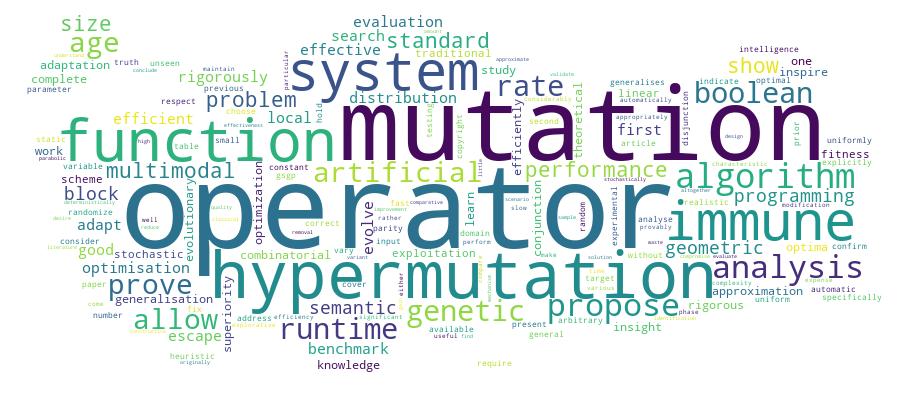
Competency Cloud

GCRIS Competency Cloud

Scholarly Output Search Results

Now showing 1 - 3 of 3
  • Article
    Citation - WoS: 19
    Citation - Scopus: 19
    Fast Immune System Inspired Hypermutation Operators for Combinatorial Optimisation
    (Institute of Electrical and Electronics Engineers Inc., 2021) Çörüş, Doğan; Oliveto, Pietro Simone; Yazdani, Donya
    Various studies have shown that immune system inspired hypermutation operators can allow artificial immune systems (AIS) to be very efficient at escaping local optima of multimodal optimisation problems. However, this efficiency comes at the expense of considerably slower runtimes during the exploitation phase compared to standard evolutionary algorithms. We propose modifications to the traditional ‘hypermutations with mutation potential’ (HMP) that allow them to be efficient at exploitation as well as maintaining their effective explorative characteristics. Rather than deterministically evaluating fitness after each bit-flip of a hypermutation, we sample the fitness function stochastically with a ‘parabolic’ distribution. This allows the ‘stop at first constructive mutation’ (FCM) variant of HMP to reduce the linear amount of wasted function evaluations when no improvement is found to a constant. The stochastic distribution also allows the removal of the FCM mechanism altogether as originally desired in the design of the HMP operators. We rigorously prove the effectiveness of the proposed operators for all the benchmark functions where the performance of HMP is rigorously understood in the literature. We validate the gained insights to show linear speed-ups for the identification of high quality approximate solutions to classical NP-Hard problems from combinatorial optimisation. We then show the superiority of the HMP operators to the traditional ones in an analysis of the complete standard Opt-IA AIS, where the stochastic evaluation scheme allows HMP and ageing operators to work in harmony. Through a comparative performance study of other ‘fast mutation’ operators from the literature, we conclude that a power-law distribution for the parabolic evaluation scheme is the best compromise in black-box scenarios where little problem knowledge is available.
  • Conference Object
    Citation - WoS: 10
    Citation - Scopus: 11
    Automatic Adaptation of Hypermutation Rates for Multimodal Optimisation
    (Assoc Computing Machinery, 2021) Corus, Dogan; Oliveto, Pietro S.; Yazdani, Donya
    Previous work has shown that in Artificial Immune Systems (AIS) the best static mutation rates to escape local optima with the ageing operator are far from the optimal ones to do so via large hypermutations and vice-versa. In this paper we propose an AIS that automatically adapts the mutation rate during the run to make good use of both operators. We perform rigorous time complexity analyses for standard multimodal benchmark functions with significant characteristics and prove that our proposed algorithm can learn to adapt the mutation rate appropriately such that both ageing and hypermutation are effective when they are most useful for escaping local optima. In particular, the algorithm provably adapts the mutation rate such that it is efficient for the problems where either operator has been proven to be effective in the literature.
  • Article
    Citation - Scopus: 2
    On the Generalisation Performance of Geometric Semantic Genetic Programming for Boolean Functions: Learning Block Mutations
    (Association for Computing Machinery, 2024) Corus, D.; Oliveto, P.S.
    In this article, we present the first rigorous theoretical analysis of the generalisation performance of a Geometric Semantic Genetic Programming (GSGP) system. More specifically, we consider a hill-climber using the GSGP Fixed Block Mutation (FBM) operator for the domain of Boolean functions. We prove that the algorithm cannot evolve Boolean conjunctions of arbitrary size that are correct on unseen inputs chosen uniformly at random from the complete truth table i.e., it generalises poorly. Two algorithms based on the Varying Block Mutation (VBM) operator are proposed and analysed to address the issue. We rigorously prove that under the uniform distribution the first one can efficiently evolve any Boolean function of constant size with respect to the number of available variables, while the second one can efficiently evolve general conjunctions or disjunctions of any size without requiring prior knowledge of the target function class. An experimental analysis confirms the theoretical insights for realistic problem sizes and indicates the superiority of the proposed operators also for small parity functions not explicitly covered by the theory. © 2024 Copyright held by the owner/author(s).