
Görçün, Ömer Faruk
Loading...

Profile URL
Name Variants
Görçün, Ö.
Görçün,Ö.F.
GÖRÇÜN, Ömer Faruk
Omer Faruk Görçün
Görçün, Ö. F.
GÖRÇÜN, ÖMER FARUK
Ömer Faruk Görçün
ÖMER FARUK GÖRÇÜN
Faruk Görçün Ö.
Gorcun, Omer Faruk
Görçün, ÖMER FARUK
Ö. Görçün
G.,Omer Faruk
Gorcun,Ö.F.
Görçün, Omer Faruk
Görçün O.
Ö. F. Görçün
Ömer Faruk GÖRÇÜN
Gorcun,Omer Faruk
Görçün Ö.
Gorcun,O.F.
Gorcun O.
Görçün, O.
G., Ömer Faruk
Omer Faruk, Gorcun
G., Omer Faruk
O. Görçün
Görçün, Ömer Faruk
Faruk Görçün,Ö.
Goercuen, oemer Faruk
Görçün, Ö.F.
Gorcuen, Omer Faruk
Faruk Görçün, Ömer
Faruk Görçün, Ö.F.
Görçün,Ö.F.
GÖRÇÜN, Ömer Faruk
Omer Faruk Görçün
Görçün, Ö. F.
GÖRÇÜN, ÖMER FARUK
Ömer Faruk Görçün
ÖMER FARUK GÖRÇÜN
Faruk Görçün Ö.
Gorcun, Omer Faruk
Görçün, ÖMER FARUK
Ö. Görçün
G.,Omer Faruk
Gorcun,Ö.F.
Görçün, Omer Faruk
Görçün O.
Ö. F. Görçün
Ömer Faruk GÖRÇÜN
Gorcun,Omer Faruk
Görçün Ö.
Gorcun,O.F.
Gorcun O.
Görçün, O.
G., Ömer Faruk
Omer Faruk, Gorcun
G., Omer Faruk
O. Görçün
Görçün, Ömer Faruk
Faruk Görçün,Ö.
Goercuen, oemer Faruk
Görçün, Ö.F.
Gorcuen, Omer Faruk
Faruk Görçün, Ömer
Faruk Görçün, Ö.F.
Job Title
Dr. Öğr. Üyesi
Email Address
Main Affiliation
Business Administration
Business Administration
01. Kadir Has University
Business Administration
01. Kadir Has University
Status
Current Staff
Website
ORCID ID
Scopus Author ID
Turkish CoHE Profile ID
Google Scholar ID
WoS Researcher ID
Sustainable Development Goals
 1
1NO POVERTY
0
Research Products
 2
2ZERO HUNGER
2
Research Products
 3
3GOOD HEALTH AND WELL-BEING
3
Research Products
 4
4QUALITY EDUCATION
1
Research Products
 5
5GENDER EQUALITY
0
Research Products
 6
6CLEAN WATER AND SANITATION
0
Research Products
 7
7AFFORDABLE AND CLEAN ENERGY
8
Research Products
 8
8DECENT WORK AND ECONOMIC GROWTH
6
Research Products
 9
9INDUSTRY, INNOVATION AND INFRASTRUCTURE
28
Research Products
 10
10REDUCED INEQUALITIES
2
Research Products
 11
11SUSTAINABLE CITIES AND COMMUNITIES
24
Research Products
 12
12RESPONSIBLE CONSUMPTION AND PRODUCTION
13
Research Products
 13
13CLIMATE ACTION
9
Research Products
 14
14LIFE BELOW WATER
10
Research Products
 15
15LIFE ON LAND
1
Research Products
 16
16PEACE, JUSTICE AND STRONG INSTITUTIONS
0
Research Products
 17
17PARTNERSHIPS FOR THE GOALS
17
Research Products

Documents
76
Citations
1322
h-index
21

Documents
68
Citations
1071

Scholarly Output
108
Articles
92
Views / Downloads
706/6346
Supervised MSc Theses
1
Supervised PhD Theses
0
WoS Citation Count
1036
Scopus Citation Count
1388
Patents
0
Projects
0
WoS Citations per Publication
9.59
Scopus Citations per Publication
12.85
Open Access Source
39
Supervised Theses
1
| Journal | Count |
|---|---|
| Engineering Applications of Artificial Intelligence | 9 |
| Expert Systems with Applications | 5 |
| Accounting, Finance, Sustainability, Governance and Fraud | 4 |
| Expert Systems With Applications | 4 |
| Journal of Cleaner Production | 3 |
Current Page: 1 / 14
Scopus Quartile Distribution
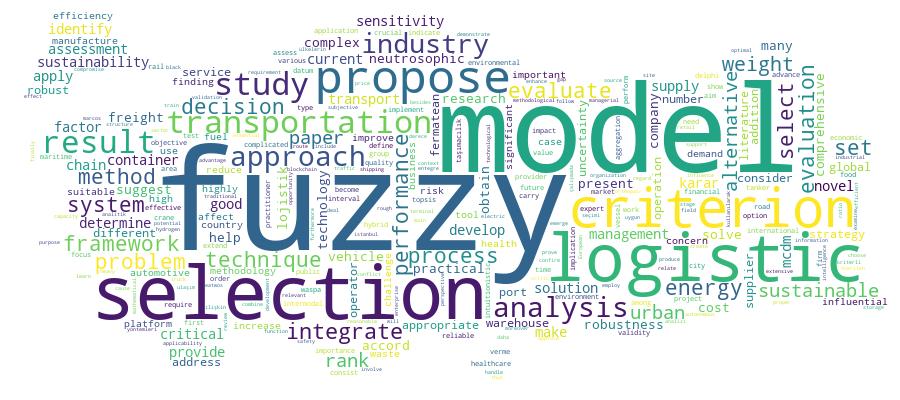
Competency Cloud
108 results
Scholarly Output Search Results
Now showing 1 - 10 of 108
Article Citation - WoS: 3Citation - Scopus: 2Assessing the Renewable Energy Sources for Sustainable Energy Generation Systems: Interval-Valued Q-Rung Orthopair Fuzzy SWARA-TOPSIS(Elsevier Ltd, 2026) Faruk Görçün, Ö.F.; Aytekin, A.; Selçuk Korucuk, S.; Tirkolaee, E.B.; Korucuk, Selcuk; Gorcun, Omer FarukRenewable Energy Sources (RESs) help decarbonize power systems, but selecting among them is a challenging decision problem due to multiple, often conflicting, technical, economic, environmental, and health-related criteria. Consequently, numerous studies in the literature have attempted to address this decision-making issue using objective, subjective, and fuzzy decision-making procedures. However, there are still unaddressed research gaps in the literature, particularly regarding the explicit modeling of expert hesitation and ambiguity in real-world RES selection cases. The current study develops a decision-making model based on Step-wise Weight Assessment Ratio Analysis (SWARA) and Technique of Order Preference Similarity to the Ideal Solution (TOPSIS) methods integrated with Interval-Valued q-Rung Orthopair Fuzzy Sets (IV-q-ROFSs) to fill these gaps. Unlike previous studies that have predominantly applied conventional fuzzy MCDM techniques, our model introduces the first integration of IV-q-ROFS into RES selection. This novelty enables a more accurate representation of expert hesitation and uncertainty. The study is applied to a real industrial case in Turkey, where six RES alternatives are evaluated across 43 criteria by five senior experts under the supervision of a three-member professionals’ board. Furthermore, the structured robustness check and systematic literature mapping ensure that the proposed approach is methodologically robust and practically relevant for policymakers and energy planners. The application results of the developed model demonstrate that the estimated energy production potential of the RES and the effects of carcinogens generated from utilizing these energy sources are the critical factors influencing the selection of the most appropriate RESs. Solar energy ranked first among the alternatives. The applicability and validity of the developed model are examined by a comprehensive robustness check consisting of tests of sensitivity, comparison, and resilience to the rank reversal problem. Overall, the study provides (i) a novel methodological framework integrating IV-q-ROFS with SWARA and TOPSIS, (ii) empirical evidence from a comprehensive real-world RES selection case, and (iii) policy-relevant insights into the drivers of renewable energy adoption. © 2025 Elsevier Ltd. All rights are reserved, including those for text and data mining, AI training, and similar technologies.Article Citation - WoS: 11Citation - Scopus: 14Evaluation of Shared Micro-Mobility Systems for Sustainable Cities by Using a Consensus-Based Fermatean Fuzzy Multiple Objective Optimization and Full Multiplicative Form(Pergamon-elsevier Science Ltd, 2024) Saha, Abhijit; Gorcun, Omer Faruk; Pamucar, Dragan; Arya, Leena; Simic, VladimirIn Turkey, the transportation industry's greenhouse gas (GHG) emissions increased by 147.1% between 1990 and 2019. Today, this transportation industry (i.e., freight and passenger) is among the significant contributors to greenhouse gas emissions in Turkey's megacities. Moreover, 65.43% of short-distance trips between home to work and home to school have been made by private automobiles in Istanbul and increasing concerns about environmental pollution have led practitioners to seek practical, robust, and effective solutions to reduce GHG emissions. Shared electric scooters have rapidly become popular for end-users and practitioners in megacities, depending on their valuable advantages. However, the rapid spread of micro-mobility, characterized by escooters, has also raised questions about this system's sustainability, suitability, and applicability. Thus, there are some critical and noteworthy gaps in this issue. This study investigates the factors affecting the suitable e-scooter selection for a sustainable urban transport system. Besides, it aims to develop a methodological framework for assessing the available e-scooter alternatives. For this purpose, a novel negotiation approach, a new form of the Delphi technique, was developed with the help of Fermatean fuzzy sets to identify the influential criteria. Also, the current paper presents a consensus-based MULTIMOORA (Multiple Objective Optimization on the basis of Ratio Analysis plus Full Multiplicative Form) decision-making model based on Fermatean fuzzy sets to address the appraisal problem concerning e-scooter selection. The current paper indicated that economic measures such as acquisition price and upkeep costs affect the e-scooter selection processes. In addition, an optimization model based on cross-entropy and dispersion measures is utilized to compute criteria weights. It highlighted that the costs of e-scooters are still high, and operators consider these criteria instead of the technical and operational features of the e-scooters. Finally, the validity check executed to test the robustness and trustworthiness of the model affirms the model's firmness and trustworthiness.Article Citation - WoS: 20Citation - Scopus: 18Efficiency Analysis of Black Sea Container Seaports: Application of an Integrated Mcdm Approach(Routledge, 2020) Ömer Faruk, GörçünThe current paper carries out an examination about the selection of the proper container seaport, which in the Black sea region. This paper focuses on a research question. Is it possible to apply multi-criteria decision-making methods that can be applied more easily than the DEA technique for decision-makers? In order to determine the best performance analysis technique that can give successful results, two-hybrid multi-criteria decision-making models were selected and operational performances of the container ports in the Black Sea region were analyzed with the help of these integrated approaches. While the first MCDM model consists of the entropy and OCRA technique, the second hybrid model consists of the Entropy and EATWIOS method. The main aim of this paper is to discuss whether these proposed hybrid models can be implemented to make an effective performance analysis for the maritime industry. The second aim of this paper is to evaluate the Black sea container seaports with the help of this suggested model. The study reveals that the proposed MCDM models can be implemented for container port selection successfully and easily and both of them have given very closer results to each other in aspects of the evaluation of the criteria and options.Article Optimizing Location Selection for Foreign Trade Intelligence Centres Using Spherical Fuzzy Methods(Pergamon-Elsevier Science Ltd, 2026) Gorcun, Omer Faruk; Cizmecioglu, Sinan; Boz, Esra; Calik, AhmetThis investigation focuses on a vital research topic that has significant research gaps in the literature, such as the selection of locations for foreign trade intelligence centres, which have a critical role in a country's development, a country's development and export capabilities. Previous studies have primarily addressed site selection in the context of manufacturing industries and retail outlets, focusing on strategies, and often ignored the unique requirements of foreign trade intelligence operations. This study solves the problem by considering the requirements of an innovative and integrated decision-making approach developed in the context of foreign trade intelligence centres, while at the same time filling the relevant research gap. The proposed model provides a mathematical form by extending Delphi management with spherical fuzzy sets to highlight influential evaluation criteria, as well as providing an integrated decision-making model extended with spherical fuzzy numbers to assess alternatives and determine rankings. Ten primary evaluation criteria are established to present a set of criteria for the authorities. The importance level of the criteria and assessments of alternatives for these criteria are aggregated spherical fuzzy numbers. A mixed integer non-linear multi-objective mathematical model is developed for the previous stages' outputs and different parameters. The results of the empirical application in Turkey show that Mersin is the most suitable alternative due to its attractive government incentives and strong commercial vitality compared to other options. The robustness checks verified the model's validity and reliability, proving a consistent decision-making tool for decision-makers and policymakers in the context of systematic decision-making.Article Citation - WoS: 22Citation - Scopus: 19Evaluation of Public Transportation Systems for Sustainable Cities Using an Integrated Fuzzy Multi-Criteria Group Decision-Making Model(Springer, 2023) Canakcioglu, Mustafa; Kundu, Pradip; Kucukonder, Hande; Gorcun, Omer Faruk; Garg, Chandra PrakashIn this era of increasing demand for mobility and rapid urban growth, there is a pressing need for a public transit system that is safe, fast, reliable, well-connected, and sustainable. Furthermore, it is essential to reduce the external costs associated with urban transportation, including environmental pollution, noise, congestion, and accidents, to foster sustainable cities. Choosing the right urban transportation system can meet this goal, but it is not an accessible business for decision-makers in the face of several conflicting criteria and ambiguities in the evaluation process. To cope with this, the current paper suggests a multi-criteria group decision-making (MCGDM) framework consisting of fuzzy BWM (Best-Worst method) and fuzzy MAIRCIA (Multi-Attribute Ideal-Real Comparative Analysis) techniques. This extended MCGDM approach has been applied to evaluate six urban transport systems, namely, Trams, Light Rail Trams, Metro (Subway), Bus Rapid Transport, Commuter Trains, and Public Buses based on 11 selection criteria which we have determined after consultation with highly experienced professionals. The fuzzy BWM technique is employed to identify the weights of the criteria. The fuzzy MAIRCA technique is utilized for ranking the alternatives using the calculated weights of the criteria. The proposed approach's validation has been examined with an extensive robustness check. The study is conducted from a general perspective, i.e., not restricted to a particular city. However, with the identified selection criteria, the proposed decision-making procedure can be repeated for a specific city considering any specific requirements, constraints, or limitations of that city.Article Citation - WoS: 22Citation - Scopus: 21Sustainable Aviation Fuel Supplier Evaluation for Airlines Through Lopcow and Marcos Approaches With Interval-Valued Fuzzy Neutrosophic Information(Elsevier Sci Ltd, 2025) Ecer, Fatih; Tanriverdi, Gokhan; Yasar, Mehmet; Gorcun, Omer FarukIn line with the 2050 net zero emission target, sustainable aviation fuel (SAF) is recognized as one of the most effective decarbonization solutions for the aviation industry, which has been identified among the critical areas for mitigating climate change. However, although sustainability issues and decarbonization have attracted scholars' attention in various terms for the airline industry, we identified some significant theoretical and managerial gaps as follows: (i) the number of studies evaluating sustainable suppliers by airlines via multicriteria decision-making (MCDM) approaches are very few, (ii) the extant literature has no paper addressing airlines' SAF supplier selection process, and (iii) no widely established criteria set in the literature to evaluate the SAF suppliers for airlines. We propose a novel model for the decision-making process of airlines' sustainable SAF supplier selection, including 39 criteria from 5 aspects considering the triple bottom of sustainability. The proposed model involves the combination of the logarithmic percentage change-driven objective weighting (LOPCOW) and measurement alternatives and ranking according to the compromise solution (MARCOS) approaches' extended forms based on the interval-valued fuzzy neutrosophic numbers (IVFNN). A comprehensive sensitivity and comparison control is further exploited to display the developed framework's robustness and practicality. Our results suggest that airlines prioritize the green initiatives of SAF suppliers over the economic aspect in the process of sustainable SAF supplier selection. We provide some managerial and policy insights for practitioners and policy-makers in the airline industry and some directions for further research.Conference Object Citation - WoS: 16Formal Safety Assessment for Ship Traffic in the Istanbul Straits(Elsevier Science Bv, 2015) Görçün, Ömer Faruk; Burak, Selmin Z.Formal Safety Assessment is a very important tool for the establishment of safety systems according to marine safety. FSA methodology has been recommended to all the maritime actors by the International Maritime Organization (IMO) as an integrated safety system. In Formal Safety Assessment two main risk methodologies are applied which are quantitative and qualitative risk assessments. Both of these methods are used together in practice. The FSA approach is applied in five main stages. In this study risks related to marine traffic in the Istanbul Strait in the period of 2001-2010 are analyzed. In practice different factors are selected for risk analyses such as vessel specifications accident locations accident time accident types and causes. (C) 2015 The Authors. Published by Elsevier Ltd.Article Citation - WoS: 6Citation - Scopus: 6Foreign Market Selection of Suppliers Through a Novel Ref-Sort Technique(Emerald Group Publishing Ltd, 2022) Aytekin, Ahmet; Gorcun, Omer Faruk; Ecer, Fatih; Pamucar, Dragan; Karamasa, CaglarPurpose The present study aims to provide a practical and robust assessment technique for assessing countries' investability in global supply chains to practitioners. Thus, the proposed approach can help decision-makers evaluate and select appropriate countries in the expansion process of the global supply chains and reduce risks concerning country (market) selection. Design/methodology/approach The present study proposes a novel decision-making approach, namely the REF-Sort technique. The proposed approach has many valuable contributions to the literature. First, it has an efficient basic algorithm and can be applied to solve highly complicated decision-making problems without requiring advanced mathematical knowledge. Besides, some characteristics differentiate REF-Sort apart from other techniques. REF-Sort employs the value or value range that reflects the most typical characteristic of the relevant class in assignment processes. The reference values in REF-Sort and center profiles are similar in this regard. On the other hand, class references can be defined as ranges in REF-Sort. Secondary values, called successors, can also be employed to assign a value to the appropriate class. REF-Sort can also determine the reference and successor values/ranges independently of the decision matrix. In addition, the proposed model is a maximally stable and consistent decision-making tool, as it is resistant to the rank reversal problem. Findings The current papers' findings indicate that countries have different features concerning investment. Hence, the current paper pointed out that only 22% of the 95 countries are investable, whereas 19% are risky. Thus, decision-makers should make detailed evaluations using robust, powerful, and practical decision-making tools to make more reasonable and logical decisions concerning country selection. Originality/value The current paper proposes a novel decision-making approach to evaluate. According to the authors' information, the proposed model has been applied to evaluate investable countries for the global supply chains for the first time.Article Selection of Fuel Supplier for Transport Firms by Using the Ahp(2020) Görçün, Ömer FarukSelection of proper fuel supplier is extremely important for companies that carry out transportation activities and it can be evaluated as a critical decision to obtain competitive advantages in the transportation market. A structural and systematic frame is suggested in this paper in order to solve the decision problems for fuel supplier selection. In order to determine the selection criteria, the board of experts was constructed and a large number of roundtable meetings that realized in the way of brainstorm were organized with them. One of the most important questions can be asked as what are the selection criteria and decision options for the fuel supplier selection process? Experts who are a decision maker in their companies tried to seek a rational answer to this question. At the end of these meetings, obtained results were re-evaluated by the members of the board and selection criteria and decision options that will use for evaluation process were determined. The decision alternatives are Brand-P, Brand-B, Brand-S, and Brand-O. The selection criteria can be sorted as: fuel price per liter, product quality, service quality, easy terms of payment, brand awareness, environmental sensitivity. Actually, selection of fuel and fuel supplier has an extremely complex characteristic and it is a multicriteria decision-making problem. In this paper, the analytic hierarchy process theory was selected as a multi-criteria decision making problem in order to solve the decision making problem concerning with fuel and fuel supplier selection process. By using this methodology, decision makers can select the best fuel brand and fuel supplier by comparing variables such as selection criteria and decision alternatives in a mathematical model.Article Virtual Reality Headsets for Employee Training in Enterprises: Fuzzy SRP Data-Driven Framework for a Comprehensive Evaluation(Springer London Ltd, 2026) Aycin, Ejder; Asan, Hakan; Ecer, Fatih; Gorcun, Omer Faruk; Ulutas, Alptekin; Pamucar, DraganVirtual reality (VR) is progressively transforming employee training in companies by offering immersive and engaging learning experiences. Nevertheless, the selection of an appropriate VR headset is vital for optimizing training effectiveness. This paper addresses this issue by proposing a novel hybrid fuzzy multi-criteria decision-making model that integrates the improved fuzzy stepwise weight assessment ratio analysis (IF-SWARA) with the fuzzy simple ranking process (F-SRP). The IF-SWARA methodology is employed to compute the relative weights of the selection criteria for VR headsets utilized in employee training, whereas the newly developed F-SRP is implemented to rank the various VR headsets. By employing the IF-SWARA method, the model offers a more nuanced understanding of criteria weights, thereby reflecting the differing significance of various headset features. The research's novelties and contributions are as follows: (1) This study is the first to select VR headsets by applying multi-criteria methods. (2) The F-SRP model is developed for the first time in the literature. (3) The introduced F-SRP methodology allows for a comprehensive ranking of the available VR headsets, facilitating informed decision-making. The paramount indicators for selecting VR headset options for training in enterprises consist of technical specifications, comfort and ergonomics, and screen specifications. The results obtained from the fuzzy SRP indicate that the Apple Vision Pro surpasses the other alternatives. Finally, the robustness and applicability of the proposed model are evaluated through an exhaustive sensitivity analysis. This research possesses broader implications for VR training in enterprises by providing a robust and reliable framework, ultimately contributing to the development of more effective and impactful VR training programs.
