Ayhan, Berkay

Loading...
Profile Picture
Name Variants
A., Berkay
AYHAN, Berkay
Berkay AYHAN
BERKAY AYHAN
AYHAN, BERKAY
Ayhan, Berkay
Ayhan,B.
Berkay Ayhan
Ayhan, B.
Ayhan,Berkay
Ayhan, BERKAY
Berkay, Ayhan
A.,Berkay
B. Ayhan
Job Title
Dr. Öğr. Üyesi
Email Address
Main Affiliation
Political Science and International Relations
Status
Current Staff
Website
Scopus Author ID
Turkish CoHE Profile ID
Google Scholar ID
WoS Researcher ID

Sustainable Development Goals

15

LIFE ON LAND
LIFE ON LAND Logo

0

Research Products

16

PEACE, JUSTICE AND STRONG INSTITUTIONS
PEACE, JUSTICE AND STRONG INSTITUTIONS Logo

0

Research Products

14

LIFE BELOW WATER
LIFE BELOW WATER Logo

0

Research Products

6

CLEAN WATER AND SANITATION
CLEAN WATER AND SANITATION Logo

0

Research Products

3

GOOD HEALTH AND WELL-BEING
GOOD HEALTH AND WELL-BEING Logo

1

Research Products

17

PARTNERSHIPS FOR THE GOALS
PARTNERSHIPS FOR THE GOALS Logo

1

Research Products

4

QUALITY EDUCATION
QUALITY EDUCATION Logo

0

Research Products

2

ZERO HUNGER
ZERO HUNGER Logo

0

Research Products

10

REDUCED INEQUALITIES
REDUCED INEQUALITIES Logo

0

Research Products

7

AFFORDABLE AND CLEAN ENERGY
AFFORDABLE AND CLEAN ENERGY Logo

0

Research Products

13

CLIMATE ACTION
CLIMATE ACTION Logo

0

Research Products

1

NO POVERTY
NO POVERTY Logo

0

Research Products

9

INDUSTRY, INNOVATION AND INFRASTRUCTURE
INDUSTRY, INNOVATION AND INFRASTRUCTURE Logo

1

Research Products

12

RESPONSIBLE CONSUMPTION AND PRODUCTION
RESPONSIBLE CONSUMPTION AND PRODUCTION Logo

0

Research Products

8

DECENT WORK AND ECONOMIC GROWTH
DECENT WORK AND ECONOMIC GROWTH Logo

2

Research Products

11

SUSTAINABLE CITIES AND COMMUNITIES
SUSTAINABLE CITIES AND COMMUNITIES Logo

1

Research Products

5

GENDER EQUALITY
GENDER EQUALITY Logo

0

Research Products
Documents

6

Citations

33

h-index

3

Documents

6

Citations

28

Scholarly Output

3

Articles

3

Views / Downloads

17/2

Supervised MSc Theses

0

Supervised PhD Theses

0

WoS Citation Count

13

Scopus Citation Count

13

WoS h-index

1

Scopus h-index

1

Patents

0

Projects

0

WoS Citations per Publication

4.33

Scopus Citations per Publication

4.33

Open Access Source

0

Supervised Theses

0

Google Analytics Visitor Traffic

JournalCount
Southeast European and Black Sea Studies2
Globalizations1
Current Page: 1 / 1

Scopus Quartile Distribution

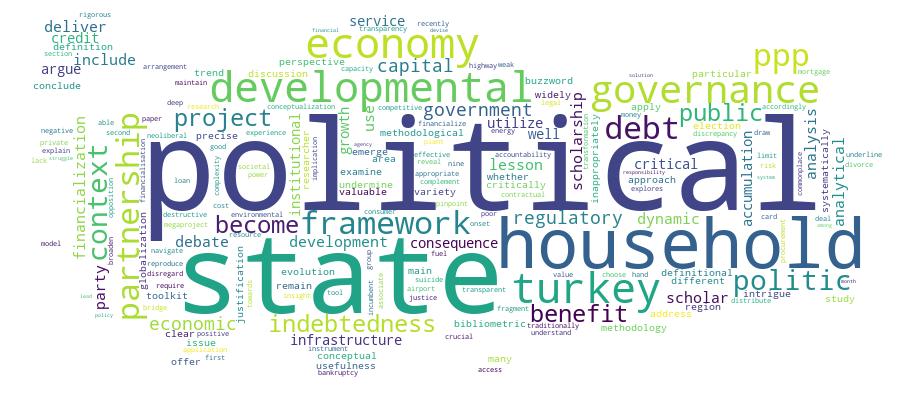
Competency Cloud

GCRIS Competency Cloud

Scholarly Output Search Results

Now showing 1 - 3 of 3
  • Article
    Politics of Household Indebtedness in Turkey
    (Routledge Journals, Taylor & Francis Ltd, 2024) Ayhan, Berkay; Aydin, Mustafa; Ulcay, Ahmet
    This paper deals with how Justice and Development Party (AKP) governments navigated the politics of household indebtedness in Turkey and utilized it towards the 2023 elections. It argues that household debt is a political tool with positive and negative consequences for incumbent governments. Households have been able to access debt instruments such as credit cards, consumer credit, car loans, and mortgages in Turkey since the onset of financialisation in the 2000s. AKP governments have benefited from the micro-level household wealth/debt accumulation as well as its macro-level economic implications for the construction-led, credit-dependent economic growth model. On the other hand, household debt has had destructive societal consequences such as bankruptcies, divorces, and suicides that became commonplace in the opposition narratives. Pinpointing the responsibility for indebtedness among households, financial system, regulatory agencies, and government, as well as devising policy solutions, has become a political struggle in the months leading up to the 2023 elections.
  • Article
    Citation - WoS: 13
    Citation - Scopus: 13
    Turkey's Public-Private Partnership Experience: a Political Economy Perspective
    (Routledge Journals, Taylor & Francis Ltd, 2023) Ayhan, Berkay; Ustuner, Yilmaz
    Public-private partnerships (PPP) are the contractual arrangements between public and private parties to deliver infrastructure and services in which costs, risks, and benefits are shared. Good governance of PPPs, traditionally associated with an effective regulatory and institutional framework, appropriate risk-sharing, competitive and transparent procurement have recently been broadened to include citizens' perspectives. Turkey uses PPPs to deliver public infrastructures such as airports, energy plants, highways, bridges, and hospitals. Our first section into Turkey's PPP experience explores how the partnership between state and capital is instituted. We reveal nine crucial governance problems: Complexities of megaprojects, fragmented legal and regulatory framework, weak institutional capacity, risk-sharing discrepancies, poor value for money, non-affordable public services, lack of transparency, limited accountability, and disregard for environmental sustainability. We maintain that a deeper understanding of PPPs requires complementing this governance analysis with insights from critical political economy. Accordingly, we draw a critical political economy framework to explain why, when, and how PPPs in Turkey are utilized in our second section. We underline the neoliberal transformation and financialized capital accumulation dynamics. We argue that PPP projects have fuelled the construction-led economic growth model, distributed resources to pro-government capital groups, and reproduced political power in Turkey.
  • Article
    Developmental State in the Context of Globalization: Definitional, Conceptual, and Methodological Issues
    (Routledge Journals, Taylor & Francis Ltd, 2025) Karaoguz, H. Emrah; Ayhan, Berkay; Albasar, Ilgi Doga
    Developmental state has offered one of the most widely used analytical toolkits to study political economy of development. One of the intriguing debates in the scholarship is whether 'conceptual stretching' undermined the analytical usefulness of the framework. While for some scholars the developmental state has just become a buzzword because the framework is applied to many different regions inappropriately, for others there are varieties of developmental states in the context of globalization. We address this debate by systematically and critically examining the developmental state scholarship, including its main trends and evolution, key discussions, methodology, and emerging areas of research. We conclude that the developmental state remains a valuable approach for researchers in the post-neoliberal political economy context, but scholars would benefit from more precise definitions, clearer justifications of why a particular conceptualization is chosen over others, and more rigorous application of research methods.