Akgül Açıkmeşe, Sinem

Loading...
Profile Picture
Name Variants
A.,Sinem
S. Akgül Açıkmeşe
Akgul Acikmese,S.
Sinem Akgül Açıkmeşe
Akgül Açıkmeşe, Sinem
Akgul-Açikmeşe S.
Akgül Açıkmeşe, SINEM
Akgul Acikmese,Sinem
A., Sinem
Akgul Acikmese S.
AKGÜL AÇIKMEŞE, SINEM
Akgül Açikmeşe S.
Sinem AKGÜL AÇIKMEŞE
Akgül-Açıkmeşe S.
Akgül Açıkmeşe,S.
Akgul Acikmese, Sinem
Sinem, Akgul Acikmese
SINEM AKGÜL AÇIKMEŞE
Akgül-Açikmeşe S.
Akgül Açıkmeşe, S.
AKGÜL AÇIKMEŞE, Sinem
Akgül Açikmeşe, S.
Akgül-Açıkmeşe, S.
Acikmese Akgul, Sinem
Açıkmeşe Akgül, Sinem
Acikmese, Sinem Akgul
Akgul-Acikmese, Sinem
Açıkmeşe, Sinem Akgül
Açikmeşe, Sinem Akgül
Akgül-Açıkmeşe, Sinem
Job Title
Prof. Dr.
Email Address
Main Affiliation
International Relations
03. Faculty of Economics, Administrative and Social Sciences
01. Kadir Has University
Status
Current Staff
Website
Scopus Author ID
Turkish CoHE Profile ID
Google Scholar ID
WoS Researcher ID

Sustainable Development Goals

15

LIFE ON LAND
LIFE ON LAND Logo

0

Research Products

16

PEACE, JUSTICE AND STRONG INSTITUTIONS
PEACE, JUSTICE AND STRONG INSTITUTIONS Logo

2

Research Products

14

LIFE BELOW WATER
LIFE BELOW WATER Logo

0

Research Products

6

CLEAN WATER AND SANITATION
CLEAN WATER AND SANITATION Logo

0

Research Products

3

GOOD HEALTH AND WELL-BEING
GOOD HEALTH AND WELL-BEING Logo

0

Research Products

17

PARTNERSHIPS FOR THE GOALS
PARTNERSHIPS FOR THE GOALS Logo

0

Research Products

4

QUALITY EDUCATION
QUALITY EDUCATION Logo

0

Research Products

2

ZERO HUNGER
ZERO HUNGER Logo

0

Research Products

10

REDUCED INEQUALITIES
REDUCED INEQUALITIES Logo

3

Research Products

7

AFFORDABLE AND CLEAN ENERGY
AFFORDABLE AND CLEAN ENERGY Logo

0

Research Products

13

CLIMATE ACTION
CLIMATE ACTION Logo

0

Research Products

1

NO POVERTY
NO POVERTY Logo

0

Research Products

9

INDUSTRY, INNOVATION AND INFRASTRUCTURE
INDUSTRY, INNOVATION AND INFRASTRUCTURE Logo

0

Research Products

12

RESPONSIBLE CONSUMPTION AND PRODUCTION
RESPONSIBLE CONSUMPTION AND PRODUCTION Logo

0

Research Products

8

DECENT WORK AND ECONOMIC GROWTH
DECENT WORK AND ECONOMIC GROWTH Logo

0

Research Products

11

SUSTAINABLE CITIES AND COMMUNITIES
SUSTAINABLE CITIES AND COMMUNITIES Logo

0

Research Products

5

GENDER EQUALITY
GENDER EQUALITY Logo

1

Research Products
Documents

15

Citations

50

h-index

4

Documents

20

Citations

60

Scholarly Output

34

Articles

17

Views / Downloads

337/3747

Supervised MSc Theses

7

Supervised PhD Theses

4

WoS Citation Count

45

Scopus Citation Count

66

WoS h-index

4

Scopus h-index

5

Patents

0

Projects

0

WoS Citations per Publication

1.32

Scopus Citations per Publication

1.94

Open Access Source

19

Supervised Theses

11

Google Analytics Visitor Traffic

JournalCount
Routledge Handbook of Conflict Response and Leadership in Africa4
Uluslararasi Iliskiler3
Southeast European and Black Sea Studies3
Journal of Balkan and Near Eastern Studies2
Journal of European Integration1
Current Page: 1 / 2

Scopus Quartile Distribution

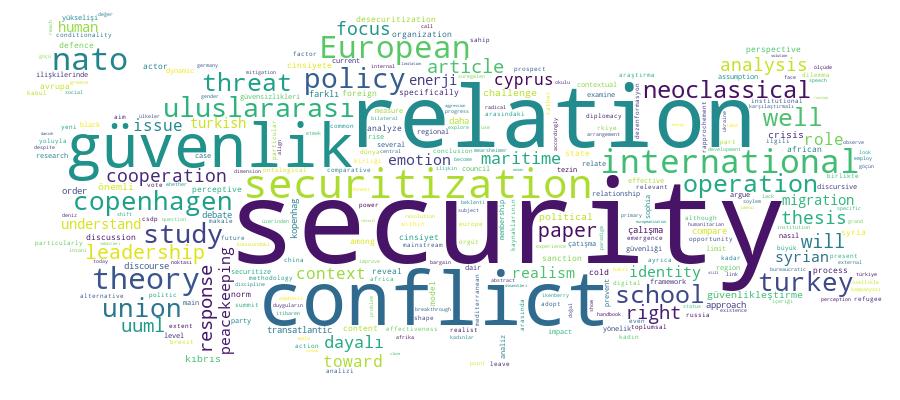
Competency Cloud

GCRIS Competency Cloud

Scholarly Output Search Results

Now showing 1 - 10 of 34
  • Article
    Uluslararası İlişkiler Kuramlarında
    (Uluslararası İlişkiler Konseyi Derneği İktisadi İşletmesi, 2015) Aydın, Mustafa; Acikmese Akgul, Sinem
    Uluslararası İlişkiler’in (Uİ) “büyük tartışma”larının sona erdiğine dair görüş alanın yazarlarının büyük çoğunluğu tarafından dile getirilmektedir. Bugün disiplinin ana dergilerinde büyük kuramsal tartışmalara yapılan atıflar önemli ölçüde azalmıştır ve en kayda değer münazaralar kuramlar/paradigmalar arasında değil, daha ziyade aynı kuramı benimseyen yazarlar arasında sıklıkla da ampirik çalışmalar üzerinden gerçekleşmektedir. Bu çalışma, Uluslararası İlişkiler’in “büyük tartışma”larının sakıncalarını ve Uİ yazınındaki “büyük tartışma”lara geri dönüş sorgulamalarını ortaya koyarak, Uİ’nin dünyada ve Türkiye’deki mevcut durumu ve geleceğine dair görüşler içermektedir. Bu noktadan hareketle, bu çalışma “büyük tartışma”lara bugüne kadar konu olan ve gelecekteki tartışmaların da temelini oluşturacak ana akımları okuyuculara yeniden hatırlatmak üzere hazırlanan bu özel sayıya giriş makalesi olarak kaleme alınmıştır.
  • Article
    Citation - WoS: 3
    Citation - Scopus: 3
    Emotions and norms in the Syrian refugee crisis: the comparative responses of the EU and Turkey
    (Routledge Journals, Taylor & Francis Ltd, 2024) Ermihan, Erman; Acikmese, Sinem Akgul
    This paper delves into the evolving research area of emotions and norms within international relations, focusing on the EU-Turkey dynamics amid the Syrian refugee crisis. Utilizing Emotion Discourse Analysis (EDA), it examines discourses from key EU and Turkish leaders between 2011 and 2023 to understand how their emotional responses to Syrian refugees influence the universal norm of human rights. Since the specific interconnection between leadership emotions and human rights norms remains largely unexplored, this study seeks to fill this gap by examining how emotions expressed by leadership in Turkey and the EU variously challenge, protect, or construct human rights norms related to Syrian refugees. Preliminary findings reveal contrasting emotional expressions: while President Erdo & gbreve;an's discourse often aligns with the protection and construction of human rights norms, EU leaders' emotions reflect a tension between human rights commitments and border security priorities.
  • Article
    Citation - Scopus: 4
    Dynamics of Cooperation and Conflict in Nato-Eu Relations
    (International Relations Council of Turkey, 2014) Akgül Açikmeşe, S.; Dizdaroğlu, C.
    NATO's supremacy in the security and defence structures of the Euro-Atlantic region during the Cold War era has prevented the development of a self-sustained European security mechanism. With the end of the Cold War, specifically with the St. Malo Summit in 1998 which was a breakthrough in the advancement of the Common Security and Defence Policy, the NATO-EU relationship became pronounced. Since then, opportunities for and difficulties of collaboration have both defined this inter-institutional relationship between NATO and the EU. Despite a series of arrangements for strengthening the institutional framework of NATO- EU relations as well as the Berlin-plus agreements, the argument of an effective cooperation between two organizations would be misguided. Particularly, discrimination against the non-EU NATO allies as well as the existence of challenges such as decoupling and duplication are hampering progress in NATO-EU relations. This article aims at shedding a light on the limited cooperation between these two organizations by focusing on the current challenges.
  • Master Thesis
    The European Union and Nato Maritime Security Cooperation in the Mediterranean
    (Kadir Has Üniversitesi, 2020) Baldıran Selen; Akgül Açıkmeşe, Sinem
    Today, Europeans are facing a large migration crisis in the Mediterranean. To tackle this humanitarian crisis, while the European Union (EU) decides maritime security operation called "Sophia" in 2015, NATO has played a supportive and complementary role to Operation Sophia in the Mediterranean with its maritime security operation called "Sea Guardian" since 2016. In this connection, the objective of the thesis work has tried to answer this research question: "To what extent is the EU and NATO maritime security cooperation effective with a specific focus on Operation Sophia and Operation Sea Guardian in the Mediterranean?" In this thesis work, for measurement of this effectiveness, the criteria based on six strategic actions for maritime security operations which are framed by the "Maritime Security Operations (MSO) Concept". In addition, for the answering of this research question, the research has made use of qualitative research methods. The data is derived from primary and secondary resources. Two organizations' official documents and presidents' speeches of both organizations' member states are used as the primary resources. Books and articles from social sciences databases are used as secondary resources. When the criteria based on six actions for MSO are analyzed, this analysis shows as follows: lack of political willingness; NATO as not the right partner for non-military issues like migration crisis; lack of maximum maritime domain awareness due to the inability of information sharing; lack of consent of the UNSCR or Libyan government for Operation Sophia's deployment from high seas to Libyan territorial waters and so the existence of some problems related to jurisdictional arrangements; and lastly even if both organizations have cooperated with commercial shipping agencies in the Mediterranean, these agencies are not the right partner for the humanitarian crisis in the Mediterranean. The result is that while the EU and NATO have very ambitions both on declarations and at summits, there are factors limiting their ongoing maritime security cooperation in the Mediterranean. In addition, the limitations of Operation Sophia have a negative effect on the EU's maritime cooperation with NATO
  • Article
    Citation - WoS: 2
    Citation - Scopus: 2
    Squaring the Circle: the Eu's Operational Impact in the Black Sea Region
    (Routledge Journals Taylor & Francis Ltd, 2014) Acikmese Akgul, Sinem; Dizdaroğlu, Cihan
    The aim of this paper is to explain the flux in the European Union (EU) policies towards the Black Sea region with a particular comparative focus on the impact of the EU's operations in the South Caucasus and the EU Border Assistance Mission (EUBAM) in Moldova. This paper adopts the prospect and process of EU enlargement towards Central and Eastern Europe as a breakthrough in the EU's deeper rapprochement with the Black Sea region. By assuming that the EU has a variety of instruments at its disposal for crisis management this paper suggests that the EU is relatively more powerful with its framework initiatives in dealing with the problems of the region at the grass-roots level more so than as a security actor assuming direct roles including the operative side of the Common Security and Defence Policy in the resolution of the regional conflicts in Abkhazia South Ossetia Nagorno-Karabakh and Transnistria. More specifically this paper argues to what extent the three-and-a-half operations in the Black Sea are successful in presenting effective solutions to the region's conflictual situations.
  • Article
    Perception or Discourse? Security Threats in Copenhagen School and Neoclassical Realism
    (2011) Acikmese Akgul, Sinem
    This article compares the perceptive approach of neoclassical realist security understanding with the discursive constructivist methodology of the Copenhagen School in analyzing the emergence of security threats. It departs from the assumption that these theories divergent in their perspectives on the content of security threats as well as security actors are comparable since they reveal methodological commonalities. The main emphasis of this article is that while partly adopting the perceptive subjectivity of neoclassical realism the Copenhagen School has further developed an alternative model of discursive intersubjectivity in analyzing security threats. In this context it will first cover the discussions on the content of security threats in Security Studies literature. It will then compare the assumptions of various realist understandings of security on the content and emergence of security threats with a particular focus on the perceptive perspective of neoclassical realism. Finally it will study the threat approach of the Copenhagen School through its securitization theory with insights from the speech-act theory political theory and discourse analysis in comparison with neoclassical realism.
  • Master Thesis
    Securitization of Migration by Radical Right in Europe: the Cases of Alternative for Germany and Danish People's Party
    (Kadir Has Üniversitesi, 2019) Albasar, İlgi Doğa; Akgül Açıkmeşe, Sinem
    International migration has been one of the most important agenda topics in Europe since the second half of the twentieth century. Especially with the developments of globalization, deterritorialized global markets and, the establishment of the Schengen area, the old assumptions of Westphalian understanding of sovereignty have challenged. With the changing global context, there has been an increasing tendency to look at the issue of international migration from the security lens. Consequently, international migration started to be seen as a security threat to European societies. This perception is gradually constructed by the involvement of multiple actors. Among those actors, radical right parties have become one of the most influential as well as the most benefiting political securitizing agents of the securitization process. Study at hand intends to analyze how radical right parties securitized migration. The Alternative for Germany (AfD) in Germany and the Danish People's Party (DF) in Denmark are selected as case studies. This analysis is conducted by following the main premises of Copenhagen School's securitization theory and its methodology of speech act. The study shows that both AfD and DF presented immigration as an existential threat to the collective identity, culture, and society of each relevant country. Furthermore, each party called for emergency measures that are necessary to be taken. In this context, the analyses show that DF has managed to securitize issues successfully between 2015-2019 whereas AfD's securitization attempt stayed at the level of securitization move.
  • Article
    Citation - WoS: 3
    Citation - Scopus: 5
    The Eu's Autonomous Sanctions Against Russia in 2014 Versus 2022: How Does the Bureaucratic Politics Model Bring in the Institutional 'balance of Power' Within the Eu?
    (Wiley, 2024) Sanus, Ekin; Akgul-Acikmese, Sinem; Karaoguz, H. Emrah
    The European Union (EU) has been more incensed over Russian aggression towards Ukraine in 2022, when compared to Russia's invasion of Crimea in 2014. This article questions this shift by looking at the EU's sanctions towards Russia. It argues that the relative unwillingness of the European Commission, and accordingly the imbalance or lopsided distribution of power within and amongst the relevant EU institutions, was one of the factors internal to the EU that prevented an effective response in 2014. Although external and contextual factors have been crucial, the EU has adopted harsher sanctions against Russia since 2022 because the Commission is not unwilling to act as it was in 2014, and dissenting members have found it difficult to obstruct the process in the Council of the EU. This article also extends the analytical repertoire of the bureaucratic politics model by demonstrating that it retains explanatory power even when the traditional parameters remain constant over time.
  • Master Thesis
    The Rise of China's Power: The Limits of Neorealism and Neoliberalism
    (Kadir Has Üniversitesi, 2018) Avcı, Fırat; Akgül Açıkmeşe, Sinem
    Rise of China is one of today's main concerns for the future of the World order. There are different interpretations of China's rise. The aim of this thesis is to explain the power direction of the rise of China; from the universal comparative perspectives of neorealism and neoliberalism, with a specific discussion on the divergent approaches of John Joseph Mearsheimer representing the neorealist camp and Gilford John Ikenberry representing the neoliberal camp. The main research question is as follows: "In what ways Mearsheimer's and Ikenberry's ideas are helpful or fail to understand the rise of China, and is there a better way to analyse China's power direction?" In this context, this study will provide a clearer and more balanced picture of China's power by uncovering strengths and weaknesses of both camps.
  • Article
    Securitization and Digital Diplomacy: Zelenskyy's 'Security-Tweet' During the Russia-Ukraine War
    (Routledge Journals, Taylor & Francis Ltd, 2025) Eryigit, Azade S.; Akgul-Acikmese, Sinem; Karaoguz, H. Emrah
    This article explores the link between social media and securitization in the context of the Russia-Ukraine war, post-February 2022, by employing the main tenets of the Copenhagen and Paris Schools. Zelenskyy's primary objectives in employing securitization language were to advance EU candidacy, garner support for the closure of the Turkish Straits, and secure US aid for Ukraine, as well as sanctions against Russia. Our geospatial analysis of retweets of Zelenskyy's posts indicates that the public accepted Zelenskyy's securitization moves in Europe, T & uuml;rkiye, and the US. Our further qualitative analysis reveals that Zelenskyy convinced enabling audiences that Russia is a threat not only to Ukraine, but to all of Europe and the world. Although it cannot be claimed that Zelenskyy's digital diplomacy alone caused the policy outcomes, our analysis illustrates how political leaders may use digital diplomacy in times of crisis to shape a discursive environment that justifies their policy preferences.