Aykut, Itır Sinem

Loading...
Profile Picture
Name Variants
Aykut, Itır Sinem
I.,Aykut
I. S. Aykut
Itır Sinem, Aykut
Aykut, Itir Sinem
I.,Aykut
I. S. Aykut
Itir Sinem, Aykut
Job Title
Email Address
Main Affiliation
Business Administration
Status
Former Staff
Website
ORCID ID
Scopus Author ID
Turkish CoHE Profile ID
Google Scholar ID
WoS Researcher ID

Sustainable Development Goals

13

CLIMATE ACTION
CLIMATE ACTION Logo

0

Research Products

2

ZERO HUNGER
ZERO HUNGER Logo

0

Research Products

7

AFFORDABLE AND CLEAN ENERGY
AFFORDABLE AND CLEAN ENERGY Logo

0

Research Products

11

SUSTAINABLE CITIES AND COMMUNITIES
SUSTAINABLE CITIES AND COMMUNITIES Logo

0

Research Products

15

LIFE ON LAND
LIFE ON LAND Logo

0

Research Products

14

LIFE BELOW WATER
LIFE BELOW WATER Logo

0

Research Products

8

DECENT WORK AND ECONOMIC GROWTH
DECENT WORK AND ECONOMIC GROWTH Logo

0

Research Products

3

GOOD HEALTH AND WELL-BEING
GOOD HEALTH AND WELL-BEING Logo

0

Research Products

5

GENDER EQUALITY
GENDER EQUALITY Logo

0

Research Products

9

INDUSTRY, INNOVATION AND INFRASTRUCTURE
INDUSTRY, INNOVATION AND INFRASTRUCTURE Logo

0

Research Products

12

RESPONSIBLE CONSUMPTION AND PRODUCTION
RESPONSIBLE CONSUMPTION AND PRODUCTION Logo

0

Research Products

16

PEACE, JUSTICE AND STRONG INSTITUTIONS
PEACE, JUSTICE AND STRONG INSTITUTIONS Logo

0

Research Products

1

NO POVERTY
NO POVERTY Logo

0

Research Products

6

CLEAN WATER AND SANITATION
CLEAN WATER AND SANITATION Logo

0

Research Products

17

PARTNERSHIPS FOR THE GOALS
PARTNERSHIPS FOR THE GOALS Logo

1

Research Products

4

QUALITY EDUCATION
QUALITY EDUCATION Logo

0

Research Products

10

REDUCED INEQUALITIES
REDUCED INEQUALITIES Logo

1

Research Products
This researcher does not have a Scopus ID.
This researcher does not have a WoS ID.
Scholarly Output

1

Articles

0

Views / Downloads

3/0

Supervised MSc Theses

1

Supervised PhD Theses

0

WoS Citation Count

0

Scopus Citation Count

0

WoS h-index

0

Scopus h-index

0

Patents

0

Projects

0

WoS Citations per Publication

0.00

Scopus Citations per Publication

0.00

Open Access Source

1

Supervised Theses

1

Journals data is not available

Scopus Quartile Distribution

Quartile distribution chart data is not available

Competency Cloud
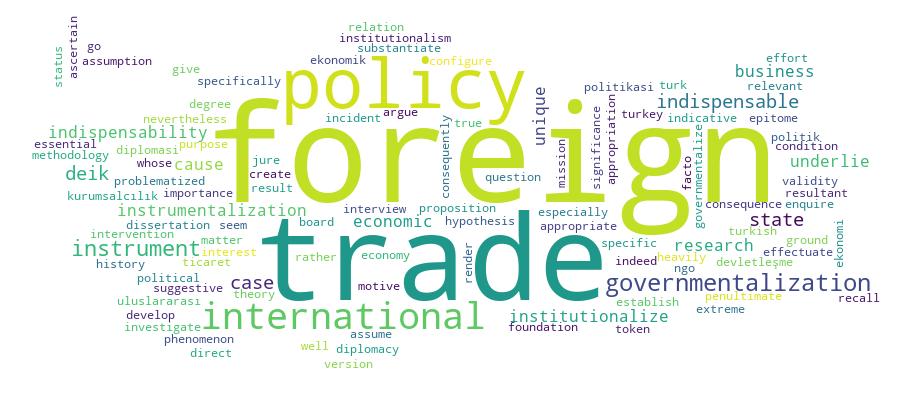
GCRIS Competency Cloud

Scholarly Output Search Results

Now showing 1 - 1 of 1
  • Master Thesis
    Is International Trade an Indispensable Instrument of Foreign Policy the Case of the Governmentalization of Deik, the Foreign Economic Relations Board of Turkey
    (Kadir Has Üniversitesi, 2019) Aykut, Itır Sinem; Triantaphyllou, Dimitrios
    The dissertation is based on the proposition that international trade is an indispensable instrument of foreign policy and the case of DEIK's governmentalization is the epitome of this instrumentalization. DEIK's governmentalization, is problematized specifically, because it ascertains a unique incident in which a state goes so far as to appropriate an NGO whose penultimate mission is international trade. The research question consequently enquires about the validity of the assumption of the indispensability of trade in foreign policy and that of foreign policy in trade. History and theory are researched in an effort to substantiate relevant explanations. An in-depth interview methodology is assumed to configure the motives as to why DEIK indeed was governmentalized in the interest of establishing the grounds for the indispensable instrumentalization of trade in foreign policy. The hypothesis is developed to argue that if the indispensability of international trade and especially its institutionalized version as an instrument of foreign policy is true, then this extreme case of direct state intervention by way of appropriation of a business NGO is suggestive of the degree of importance international trade has vis à vis foreign policy and by the same token foreign policy vis-à-vis international trade. The underlying causes are to be investigated; nevertheless, no matter what the specific foundations, the resulting condition recalls one essential inference: this act of governmentalization of a business NGO, by the unique way it has been effectuated, as well as the new status created as a consequence, seems to render all underlying causes other than the significance given to institutionalized trade as an instrument of foreign policy, rather marginal. The resultant phenomenon is heavily indicative of not only a de facto but also a de jure instrumentalization by the state of an NGO in international trade, for the purposes of foreign policy.