Akser, Ali Murat

Loading...
Profile Picture
Name Variants
Akser, Ali Murat
A.,Akser
A. M. Akser
Ali Murat, Akser
Akser, Ali Murat
A.,Akser
A. M. Akser
Ali Murat, Akser
Akser, Murat
Akser, Murat
Job Title
Dr. Öğr. Üyesi
Email Address
Main Affiliation
New Media
Status
Former Staff
Website
ORCID ID
Scopus Author ID
Turkish CoHE Profile ID
Google Scholar ID
WoS Researcher ID

Sustainable Development Goals

4

QUALITY EDUCATION
QUALITY EDUCATION Logo

0

Research Products

6

CLEAN WATER AND SANITATION
CLEAN WATER AND SANITATION Logo

0

Research Products

10

REDUCED INEQUALITIES
REDUCED INEQUALITIES Logo

0

Research Products

13

CLIMATE ACTION
CLIMATE ACTION Logo

0

Research Products

14

LIFE BELOW WATER
LIFE BELOW WATER Logo

1

Research Products

2

ZERO HUNGER
ZERO HUNGER Logo

0

Research Products

8

DECENT WORK AND ECONOMIC GROWTH
DECENT WORK AND ECONOMIC GROWTH Logo

0

Research Products

12

RESPONSIBLE CONSUMPTION AND PRODUCTION
RESPONSIBLE CONSUMPTION AND PRODUCTION Logo

0

Research Products

9

INDUSTRY, INNOVATION AND INFRASTRUCTURE
INDUSTRY, INNOVATION AND INFRASTRUCTURE Logo

0

Research Products

17

PARTNERSHIPS FOR THE GOALS
PARTNERSHIPS FOR THE GOALS Logo

0

Research Products

1

NO POVERTY
NO POVERTY Logo

0

Research Products

11

SUSTAINABLE CITIES AND COMMUNITIES
SUSTAINABLE CITIES AND COMMUNITIES Logo

1

Research Products

15

LIFE ON LAND
LIFE ON LAND Logo

0

Research Products

3

GOOD HEALTH AND WELL-BEING
GOOD HEALTH AND WELL-BEING Logo

0

Research Products

7

AFFORDABLE AND CLEAN ENERGY
AFFORDABLE AND CLEAN ENERGY Logo

0

Research Products

5

GENDER EQUALITY
GENDER EQUALITY Logo

4

Research Products

16

PEACE, JUSTICE AND STRONG INSTITUTIONS
PEACE, JUSTICE AND STRONG INSTITUTIONS Logo

4

Research Products
This researcher does not have a Scopus ID.
This researcher does not have a WoS ID.
Scholarly Output

33

Articles

8

Views / Downloads

24/0

Supervised MSc Theses

19

Supervised PhD Theses

1

WoS Citation Count

136

Scopus Citation Count

155

WoS h-index

5

Scopus h-index

3

Patents

0

Projects

0

WoS Citations per Publication

4.12

Scopus Citations per Publication

4.70

Open Access Source

31

Supervised Theses

20

JournalCount
Cinej Cinema Journal6
CINEJ Cinema Journal1
Historical Journal of Film, Radio and Television1
Media and Communication1
Middle East Journal Of Culture And Communication1
Current Page: 1 / 2

Scopus Quartile Distribution

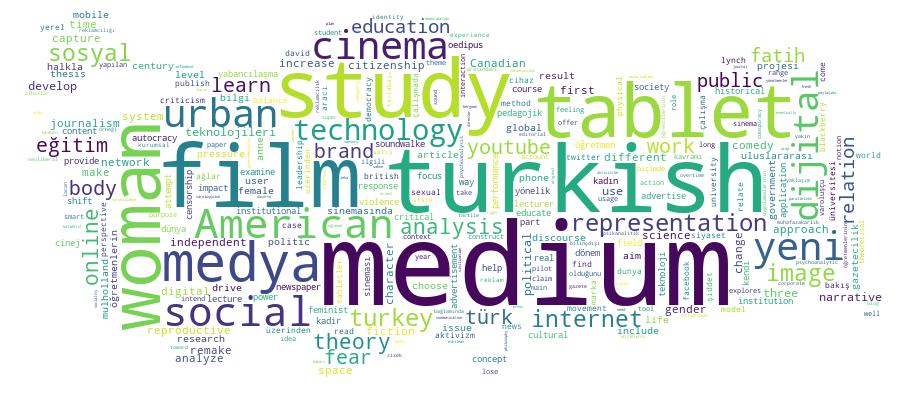
Competency Cloud

GCRIS Competency Cloud

Scholarly Output Search Results

Now showing 1 - 10 of 33
  • Master Thesis
    Gazete Yayıncılığında Muhafazakarlık Söyleminin Değişimi 2003 - 2008
    (Kadir Has Üniversitesi, 2012) Aydın, Sumru; Akser, Murat
    Bu tez, 2003 ve 2008 yıllarında kadına yönelik şiddet haberlerinde muhafazakarlık söyleminin seçilmiş üç gazetede nasıl değiştiğini göstermeyi amaçlamaktadır. Seçilen gazetelere ait haberler niceliksel ve niteliksel olarak incelenmiştir. Kadına yönelik şiddet haberlerinde üç gazetenin aynı olayı farklı yaklaşımlarla haber yaptığı saptanmıştır. Bu yaklaşımlar suçlama, örtme ve abartma olarak özetlenebilir.
  • Master Thesis
    Yakın Dönem Türk Sinemasında Varoşculuk ve Yabancılaşma
    (Kadir Has Üniversitesi, 2013) Nas, İrem; Akser, Murat
    20. yüzyıl insanının en büyük problemlerinden olan yabancılaşma sorununun, incelenecek yakın dönem Türk sineması örneklerinde varoluşçu felsefe açısından nasıl yorumlandığı, ne şekilde kurgulandığı ve akımın yabancılaşmayı gösterme bağlamında etkilerinin son dönemde yoğunluk kazanmasının nedenlerini ortaya koymak çalışmamın amacı olacaktır. Tez çalışmasının birinci bölümünde kavram olarak varoluşçuluk ve varoluşçu felsefe akımı içindeki yabancılaşma tanımlarına değinilecek, ikinci bölümde varoluşçuluğun dünya ve Türk sinemasındaki etkilerine yer verilecektir. Üçüncü bölümde de Türk sinemasının üç genç yönetmeninin filmi (Semih Kaplanoğlu/Meleğin Düşüşü, Özcan Alper/Sonbahar, Seren Yüce/Çoğunluk) varoluşçu izlekler açısından incelenecektir.
  • Master Thesis
    Never Satisfied: Dissatisfied Women, Hysteric Men in 1980s Turkey
    (Kadir Has Üniversitesi, 2012) Gökçem, Selen; Akser, Murat
    The feminist movement in the 1980s Turkey enabled women to question women?s sexual emancipation. The raise of educated women, individuality and sexual emancipation helped shaping the new educated urban women image in the 1980s Turkey. The woman directors of 1980s Turkey made several women themed films in which the woman characters were represented as educated, working, economically free and sexually emancipated. Yet, the representation of sexually emancipated women in these films resulted in women hysteria. This study identifies the representation of 1980s educated emancipated women in Turkish woman directors? films that resulted in three basic outcomes; they are women hysteria, male hysteria and women?s self-sacrifice
  • Article
    Citation - Scopus: 1
    Finding Leadership in Media Education
    (Univ Pittsburgh, Univ Library System, 2024) Baybars, Banu; Akser, Murat
    This article is an exploration of leadership in media education and some of its identifying features. As lecturers in media studies and production, our teaching philosophy weaves through these themes: active learning (Budhai 2021), learning by doing (Schank et al 2013), peer and self-assessment (Iglesias P & eacute;rez, Vidal-Puga, and Pino Juste 2022) and constructive alignment (Loughlin, Lygo-Baker and Lindberg-Sand 2021).
  • Master Thesis
    Yeni medya ve dijital aktivizm
    (Kadir Has Üniversitesi, 2012) Özcan, Fethi Feyyaz; Akser, Murat
    Çağımızın en yaygın kullanılan kitle iletişim aracı internettir. 1960’larda Marshall Luhanin öngörüsü olan global village kavramı ve 90’lar Pierre Levy’nin öngörüsü bilgi toplumu ve kollektif zeka kavramı gerçeğe dönüşmüştür. Bu öngörülerin günümüze yansıması dijital aktivizm olmuştur. Dijital aktivistlerin gerçekleştirdiği dijital aktivist hareketler neticesinde dünyanın cehresi değişmiştir. Toplumlar bu eylemlerle seslerini duyurmuştur. Hatta wikileaks le başlayıp Arap baharı ve öfkeliler hareketi olarak devam eden süreçte birçok devletin yapısının değişmesine neden olmuşlardır. Hemen hemen her ülkede dijital aktivistler sahne almıştır.
  • Article
    Return To Reality: Towards a More Tactile Cognition of Film Theory
    (Univ Pittsburgh, Univ Library System, 2012) Akser, Murat
    Film theory has lost itself in the woods among debates of the mind and the senses. Ther are those who are interested in a more tactile sense of the real in film studies. This issue of CINEJ focuses on the documentary truth and how it aims to present us a real and a better world.
  • Article
    Citation - WoS: 92
    Citation - Scopus: 116
    Media and Democracy in Turkey: Toward a Model of Neoliberal Media Autocracy
    (2012) Baybars Hawks, Banu; Akser, Murat
    This paper reveals the ways in which media autocracy operates on political, judicial, economic and discursive levels in post-2007 Turkish media. Newsmakers in Turkey currently experience five different systemic kinds of neoliberal government pressures to keep their voice down: conglomerate pressure, judicial suppression, online banishment, surveillance defamation and accreditation discrimination. The progression of restrictions on media freedom has increased in volume annually since 2007; this includes pressure on the Dogan Media Group, the YouTube ban, arrests of journalists in the Ergenekon trials, phone tapping/taping of political figures and the exclusion of all unfriendly reporters from political circles. The levels and tools of this autocracy eventually lead to certain conclusions about the qualities of this media environment: it is a historically conservative, redistributive, panoptic and discriminatory media autocracy.
  • Conference Object
    Digital Citizenship From Below: Turkish State Versus Youtube
    (Int Business Information Management Assoc-Ibima, 2018) Baybars Hawks, Banu; Akser, Murat
    This study aims to give a historically situated analysis of the YouTube ban as seen by Turkish internet users during the first YouTube ban period between 2007-10. The content is used from online Turkish anonymous user platform, eksi sozluk, (sour dictionary). The aim is to test whether there is a civil society response to the ban which political elites and ordinary citizens contest the necessity of access to global social media networks. The main focus of this research paper is the kinds of discourse the Turkish online community used to protest the ban during the first YouTube ban. Through a combination content analysis and discourse analysis the bloggers reactions are coded and indexed to decipher the discourse produced as an active resistance/criticism against the YouTube. The response to YouTube ban that come from Turkish internet users (from below) and was critical in times of global events effecting the usage of internet and was not silenced between these events. As long as they remained anonymous (not organized action) Turkish bloggers utilized their rights for online expression. Frequency of critical blog entries increase in times of events critical of government's YouTube ban. The response to the ban is either based on condemning it or offering ways around the ban; but not calling for united action. Anonymity of the user increases the level of criticism and participation. Finally, both the government authorities and NGOs expect individual action but demand organized corporate action
  • Article
    Citation - WoS: 19
    Citation - Scopus: 26
    Repressed media and illiberal politics in Turkey: the persistence of fear
    (Routledge Journals, Taylor & Francis Ltd, 2023) Akser, Murat; Baybars, Banu
    This article examines the historical roots of the role of successive Turkish governments' fear of media and Turkish media's fear of government authority with respect to the development of press freedom over the long run and closely analyzes the historical pressures imposed on journalists through legal and informal means. We focus particularly on the economic and political pressure on the media in Turkey and offer three arguments regarding the fear in Turkish media: (1) Media fear is historical rather than a rupture that happened during the Justice and Development Party era; (2) out of fear of losing power, the governments use structural, legislative and extra-legal factors to the advantage of the ruling party to support a friendly media-ecology; and (3) the repressed media attempt to come out of this ecology of fear by utilizing new tactics of reporting, such as alternative media and citizen journalism.
  • Editorial
    Editorial
    (Univ Pittsburgh, Univ Library System, 2013) Akser, Murat
    This issue of CINEJ deals with approaches to films from different parts of the world ranging from India and China to Italy and Canada. Detailed analyses on films about Ghandi, docufictions on New York City, reflections of contemporary terror in historical cinema, Chinese Soft Film Movement, road movies, religious identification in films, documemory, Italian neorealism and female performance in Canadian cinema are presented in this issue.