Yıldırım, Kaan Can

Loading...
Profile Picture
Name Variants
Yıldırım, K.
Yildirim,K.C.
Yildirim,Kaan Can
YILDIRIM, KAAN CAN
KAAN CAN YILDIRIM
K. C. Yıldırım
YILDIRIM, Kaan Can
Yıldırım, KAAN CAN
Yildirim, Kaan Can
Yıldırım,K.C.
K. Yıldırım
Yıldırım, K. C.
Y., Kaan Can
Kaan Can, Yildirim
Kaan Can YILDIRIM
Yıldırım, Kaan Can
Y.,Kaan Can
Kaan Can Yıldırım
Job Title
Araş. Gör.
Email Address
Main Affiliation
Law
Status
Current Staff
Website
Scopus Author ID
Turkish CoHE Profile ID
Google Scholar ID
WoS Researcher ID

Sustainable Development Goals

15

LIFE ON LAND
LIFE ON LAND Logo

0

Research Products

16

PEACE, JUSTICE AND STRONG INSTITUTIONS
PEACE, JUSTICE AND STRONG INSTITUTIONS Logo

0

Research Products

14

LIFE BELOW WATER
LIFE BELOW WATER Logo

1

Research Products

6

CLEAN WATER AND SANITATION
CLEAN WATER AND SANITATION Logo

0

Research Products

3

GOOD HEALTH AND WELL-BEING
GOOD HEALTH AND WELL-BEING Logo

0

Research Products

17

PARTNERSHIPS FOR THE GOALS
PARTNERSHIPS FOR THE GOALS Logo

0

Research Products

4

QUALITY EDUCATION
QUALITY EDUCATION Logo

0

Research Products

2

ZERO HUNGER
ZERO HUNGER Logo

0

Research Products

10

REDUCED INEQUALITIES
REDUCED INEQUALITIES Logo

0

Research Products

7

AFFORDABLE AND CLEAN ENERGY
AFFORDABLE AND CLEAN ENERGY Logo

0

Research Products

13

CLIMATE ACTION
CLIMATE ACTION Logo

0

Research Products

1

NO POVERTY
NO POVERTY Logo

0

Research Products

9

INDUSTRY, INNOVATION AND INFRASTRUCTURE
INDUSTRY, INNOVATION AND INFRASTRUCTURE Logo

0

Research Products

12

RESPONSIBLE CONSUMPTION AND PRODUCTION
RESPONSIBLE CONSUMPTION AND PRODUCTION Logo

0

Research Products

8

DECENT WORK AND ECONOMIC GROWTH
DECENT WORK AND ECONOMIC GROWTH Logo

0

Research Products

11

SUSTAINABLE CITIES AND COMMUNITIES
SUSTAINABLE CITIES AND COMMUNITIES Logo

0

Research Products

5

GENDER EQUALITY
GENDER EQUALITY Logo

0

Research Products
This researcher does not have a Scopus ID.
This researcher does not have a WoS ID.
Scholarly Output

2

Articles

2

Views / Downloads

7/0

Supervised MSc Theses

0

Supervised PhD Theses

0

WoS Citation Count

1

Scopus Citation Count

0

WoS h-index

1

Scopus h-index

0

Patents

0

Projects

0

WoS Citations per Publication

0.50

Scopus Citations per Publication

0.00

Open Access Source

1

Supervised Theses

0

Google Analytics Visitor Traffic

JournalCount
European Review of Private Law1
Istanbul Hukuk Mecmuasi1
Current Page: 1 / 1

Scopus Quartile Distribution

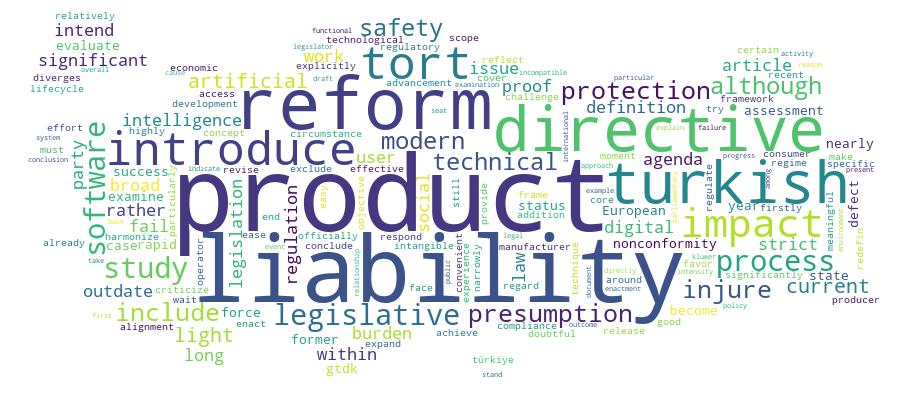
Competency Cloud

GCRIS Competency Cloud

Scholarly Output Search Results

Now showing 1 - 2 of 2
  • Article
    Citation - WoS: 1
    The Impact of Legislative Processes on the Success of Tort Reforms: A Case Study on the Turkish Product Liability Reform
    (Kluwer Law International, 2025) Yildirim, Kaan Can; Çalişkan, A.
    Although Türkiye has a significant law reform experience, the issue of product liability reform has long been troubled. Firstly, this issue was tried to be regulated within the articles included in the consumer protection legislation. Still, these efforts were highly criticized regarding law-making technique and substance. The long wait for a specific product liability legislation only ended in 2020. Law No. 7223 on Product Safety and Technical Regulations was intended to harmonize with EU legislation, particularly EU Directive 85/374/EEC. However, it is doubtful that the law has achieved this objective. In addition, it is also incompatible with modern approaches to product liability. Therefore, the Turkish product liability reform stands out as a failed tort reform. Among the reasons for this, the working system of the legislator is notable. An examination of the parliamentary documents on the drafting and enactment process of the law indicates that the law may be the outcome of functional f laws rather than a legal policy choice. In particular, the impact of the social agenda and public events on the overall progress of legislative activity is evident. This study first presents the Turkish product liability reform and explains why it has been an example of failed tort reform. Then, the relationship between this failure and the f laws in the legislative process is analysed. In conclusion, the intensity of social agendas caused tort reforms to take a back seat and directly impacted the working environment in parliament. © 2025 Kluwer Law International BV, The Netherlands.
  • Article
    An Assessment of the Current State of Turkish Law in Light of the Reforms Introduced by Directive 2024/2853 on Product Liability
    (Istanbul Univ, Fac Law, 2025) Caliskan, Alican; Yildirim, Kaan Can
    This study examines the significant reforms introduced by the European Union's New Product Liability Directive (2024/2853) and evaluates the current status of Turkish product liability law in light of these changes. The former Directive 85/374, in force for nearly 40 years, had become outdated due to rapid technological advancements and digitalization. The new Directive responds to these developments by explicitly including software and artificial intelligence within the definition of "product," introducing presumptions that ease the burden of proof for injured parties, expanding liability to cover not only manufacturers but also broader economic operators, and redefining the moment of liability to include, under certain circumstances, the lifecycle of the product-not just its release date. In this way, it is intended to make it easier for those injured to access broader protection in a more convenient way. In Turkish law, although Law No. 7223 on Product Safety and Technical Regulations, enacted in 2020, officially introduced strict liability for producers, it diverges significantly from the new Directive in key areas. The definition of product excludes intangible digital products like software, no presumptions are provided in favor of injured parties, and the concept of "nonconformity" is framed narrowly around technical regulatory compliance rather than user safety expectations. The article concludes that Turkey's product liability regime, although relatively recent, is already outdated in the face of modern challenges and EU standards. For meaningful alignment and effective user protection in the digital age, the Turkish framework must be revised to better reflect the core objectives and modern scope of the new EU Directive.