Ceylan, Oğuzhan

Loading...
Profile Picture
Name Variants
Oğuzhan Ceylan
CEYLAN, OĞUZHAN
Ceylan, OĞUZHAN
Ceylan, Oguzhan
CEYLAN, Oğuzhan
Ceylan,Oguzhan
Oğuzhan CEYLAN
OĞUZHAN CEYLAN
C., Oguzhan
Ceylan,O.
C.,Oguzhan
Oguzhan, Ceylan
C., Oğuzhan
Ceylan, Oğuzhan
Ceylan O.
Ceylan, O.
O. Ceylan
Ceylan, Oğuzhan
Ceylan, O?uzhan
Oguzhan, C.
Job Title
Doç. Dr.
Email Address
Main Affiliation
Management Information Systems
03. Faculty of Economics, Administrative and Social Sciences
01. Kadir Has University
Status
Current Staff
Website
Scopus Author ID
Turkish CoHE Profile ID
Google Scholar ID
WoS Researcher ID

Sustainable Development Goals

11

SUSTAINABLE CITIES AND COMMUNITIES
SUSTAINABLE CITIES AND COMMUNITIES Logo

1

Research Products

10

REDUCED INEQUALITIES
REDUCED INEQUALITIES Logo

0

Research Products

9

INDUSTRY, INNOVATION AND INFRASTRUCTURE
INDUSTRY, INNOVATION AND INFRASTRUCTURE Logo

1

Research Products

12

RESPONSIBLE CONSUMPTION AND PRODUCTION
RESPONSIBLE CONSUMPTION AND PRODUCTION Logo

0

Research Products

2

ZERO HUNGER
ZERO HUNGER Logo

0

Research Products

3

GOOD HEALTH AND WELL-BEING
GOOD HEALTH AND WELL-BEING Logo

0

Research Products

13

CLIMATE ACTION
CLIMATE ACTION Logo

1

Research Products

7

AFFORDABLE AND CLEAN ENERGY
AFFORDABLE AND CLEAN ENERGY Logo

37

Research Products

5

GENDER EQUALITY
GENDER EQUALITY Logo

0

Research Products

6

CLEAN WATER AND SANITATION
CLEAN WATER AND SANITATION Logo

0

Research Products

8

DECENT WORK AND ECONOMIC GROWTH
DECENT WORK AND ECONOMIC GROWTH Logo

2

Research Products

16

PEACE, JUSTICE AND STRONG INSTITUTIONS
PEACE, JUSTICE AND STRONG INSTITUTIONS Logo

0

Research Products

4

QUALITY EDUCATION
QUALITY EDUCATION Logo

0

Research Products

15

LIFE ON LAND
LIFE ON LAND Logo

1

Research Products

1

NO POVERTY
NO POVERTY Logo

0

Research Products

14

LIFE BELOW WATER
LIFE BELOW WATER Logo

0

Research Products

17

PARTNERSHIPS FOR THE GOALS
PARTNERSHIPS FOR THE GOALS Logo

1

Research Products
Documents

110

Citations

1086

h-index

16

This researcher does not have a WoS ID.
Scholarly Output

81

Articles

23

Views / Downloads

73/0

Supervised MSc Theses

3

Supervised PhD Theses

0

WoS Citation Count

453

Scopus Citation Count

714

WoS h-index

10

Scopus h-index

13

Patents

0

Projects

0

WoS Citations per Publication

5.59

Scopus Citations per Publication

8.81

Open Access Source

20

Supervised Theses

3

JournalCount
2021 56th International Universities Power Engineering Conference (Upec 2021): Powering Net Zero Emissions4
2025 60th International Universities Power Engineering Conference, UPEC 2025 -- 60th International Universities Power Engineering Conference, UPEC 2025 -- 2 September 2025 through 5 September 2025 -- London -- 2181513
2018 53rd International Universities Power Engineering Conference (UPEC)3
2019 54th International Universities Power Engineering Conference (UPEC)3
2020 55th International Universities Power Engineering Conference (UPEC)2
Current Page: 1 / 11

Scopus Quartile Distribution

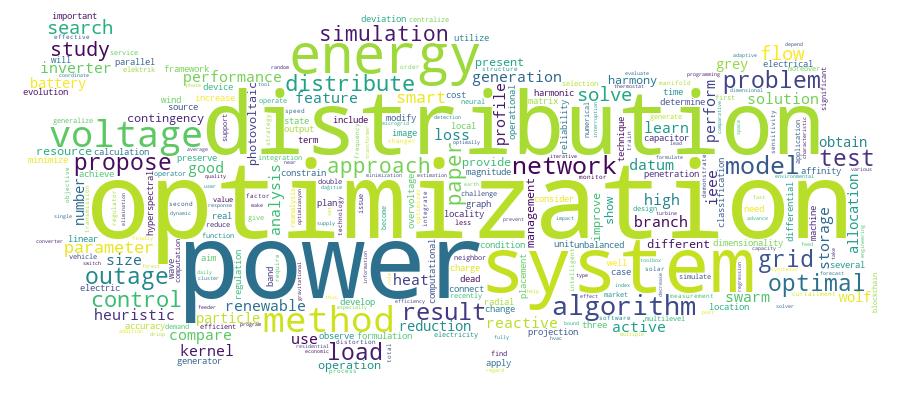
Competency Cloud

GCRIS Competency Cloud

Scholarly Output Search Results

Now showing 1 - 10 of 81
  • Conference Object
    Citation - WoS: 8
    Citation - Scopus: 12
    Allocation of Distributed Generators Using Parallel Grey Wolf Optimization
    (IEEE, 2021) Younesi, Soheil; Ahmadi, Bahman; Ceylan, Oguzhan; Ozdemir, Aydogan
    This paper solves the allocation problem of distributed generators (DGs) in smart grids utilizing a grey wolf optimization (GWO) algorithm. By parallelizing GWO, it presents the impact of using various number of processors on speedup, efficiency. To decrease the computation time required to perform the simulations, different migration rates are applied for different number of processors. Moreover, the accuracy obtained using different number of processors is analyzed. The simulations are performed for a 33-bus distribution test system using MATLAB's parallel computing toolbox. From the simulation results it is observed that parallel GWO can be used as a tool for distribution system optimization.
  • Conference Object
    Citation - Scopus: 1
    Optimal Allocation of Distributed Generators and Mobile Battery Energy Storage Systems in Distribution System
    (Institute of Electrical and Electronics Engineers Inc., 2023) Ahmadi,B.; Ceylan,O.; Ozdemir,A.
    This research proposes an expansion planning frame-work that determines the optimal number, location, size, and type of distributed generators (DGs) and the number, capacity, location, and operation of mobile battery energy storage systems (MBESSs) in the distribution networks to improve the voltage profiles. The framework is applied to IEEE 33-bus and 69-bus standard test systems. The framework uses the advanced grey-wolf optimization (AGWO) developed to deal with mixed-integer nonlinear programming problems and the forward-backward sweep power flow method to determine the optimal control parameters defined for the problem. This study shows that the proposed framework enables the allocation and operation of DG and MBESS units to eliminate all voltage violations. Moreover, a clear roadmap is proposed for the size and location of DG units in the system and guidelines for the monthly location of MBESS. © 2023 IEEE.
  • Conference Object
    Citation - Scopus: 5
    Double Branch Outage Modeling and Its Solution Using Differential Evolution Method
    (2011) Ceylan, Oğuzhan; Ozdemir, Aydogan; Dağ, Hasan
    Power system operators need to check the system security by contingency analysis which requires power flow solutions repeatedly. AC power flow is computationally slow even for a moderately sized system. Thus fast and accurate outage models and approximated solutions have been developed. This paper adopts a single branch outage model to a double branch outage one. The final constrained optimization problem resulted from modeling is then solved by using differential evolution method. Simulation results for IEEE 30 and 118 bus test systems are presented and compared to those of full AC load flow in terms of solution accuracy. © 2011 IEEE.
  • Conference Object
    Graph Optimized Locality Preserving Projection Via Heuristic Optimization Algorithms
    (IEEE, 2019) Ceylan, Oğuzhan; Taşkın, Gülşen
    Dimensionality reduction has been an active research topic in hyperspectral image analysis due to complexity and non-linearity of the hundreds of the spectral bands. Locality preserving projection (LPP) is a linear extension of the manifold learning and has been very effective in dimensionality reduction compared to linear methods. However, its performance heavily depends on construction of the graph affinity matrix, which has two parameters need to be optimized: k-nearest neighbor parameter and heat kernel parameter. These two parameters might be optimally chosen simply based on a grid search when using only one representative kernel parameter for all the features, but this solution is not feasible when considering a generalized heat kernel in construction the affinity matrix. In this paper, we propose to use heuristic methods, including harmony search (HS) and particle swarm optimization (PSO), in exploring the effects of the heat kernel parameters on embedding quality in terms of classification accuracy. The preliminary results obtained with the experiments on the hyperspectral images showed that HS performs better than PSO, and the heat kernel with multiple parameters achieves better performance than the isotropic kernel with single parameter.
  • Conference Object
    Citation - WoS: 1
    Citation - Scopus: 3
    Feature Selection Using Self Organizing Map Oriented Evolutionary Approach
    (Ieee, 2021) Ceylan, Oguzhan; Taskin, Gulsen
    Hyperspectral images are the multidimensional matrices consisting of hundreds of spectral feature vectors. Thanks to these large number of features, the objects on the Earth having similar spectral characteristics can easily be distinguished from each other. However, the high correlation and the noise between these features cause a significant decrease in the classification performances, especially in the supervised classification tasks. In order to overcome these problems, which is known in the literature as Hughes's effects or curse of dimensionality, dimensionality reduction techniques have frequently been used. Feature selection and feature extraction methods are the ones used for this purpose. The feature selection methods aim to remove the features, including high correlation and noise, out of the original feature set. In other words, a subset of relevant features that have the ability to distinguish the objects is determined. The feature extraction methods project the high dimensional space into a lower-dimensional feature space based on some optimization criterion, and hence they distort the original characteristic of the dataset. Therefore, the feature selection methods are more preferred than the feature extraction methods since they preserve the originality of the dataset. Based on this motivation, an evolutionary based optimization algorithm utilizing self organizing map was accordingly modified to provide a new feature selection method for the classification of hyperspectral images. The proposed method was compared to well-known feature selection methods in the classification of two hyperspectral datasets: Botswana and Indian Pines. According to the preliminary results, the proposed method achieves higher performance over other feature selection methods with a very less number of features.
  • Article
    Citation - WoS: 38
    Citation - Scopus: 52
    A Multi-Objective Optimization Evaluation Framework for Integration of Distributed Energy Resources
    (Elsevier, 2021) Ahmadi, Bahman; Ceylan, Oguzhan; Ozdemir, Aydogan
    Renewable distributed generation and energy storage systems (ESSs) have been a gamechanger for a reliable and sustainable energy supply. However, this new type of generation should be optimally planned and operated to maximize the expected benefits. In this regard, this paper presents a new formulation for optimal allocation and sizing of distributed energy resources and operation of ESSs to improve the voltage profiles and minimize the annual costs. The multi-objective multiverse optimization method (MOMVO) is used as a solution tool. Moreover, the resulting Pareto optimal solution set is minimized under economic concerns and cost sensitivity to provide a decision-support for the utilities. The proposed formulation and solution algorithm are tested for the revised 33-bus and 69-bus test systems where the load and renewable generation characteristics are taken from real Turkish data. When compared with the base case operating conditions, the proposed formulation eliminated all the voltage magnitude violations, and provided almost 50% loss reductions and 20% energy transfers to off-peak hours. Moreover, Pareto fronts of the proposed method are found to better than the ones provided by non dominated sorting genetic algorithm and multi-objective particle swarm optimization, according to two multi-objective optimization metrics.
  • Conference Object
    Citation - WoS: 2
    Citation - Scopus: 2
    A Topology Detector Based Power Flow Approach for Radial and Weakly Meshed Distribution Networks
    (Ieee, 2024) Yetkin, E. Fatih; Ceylan, Oguzhan; Pisica, Ioana; Ozdemir, Aydogan
    Power distribution networks may need to be switched from one radial configuration to another radial structure, providing better technical and economic benefits. Or, they may also need to switch from a radial configuration to a meshed one and vice-versa due to operational purposes. Thus the detection of the structure of the grid is important as this detection will improve the operational efficiency, provide technical benefits, and optimize economic performance. Accurate detection of the grid structure is needed for effective load flow analysis, which becomes increasingly computationally expensive as the network size increases. To perform a proper load flow analysis, one has to build the distribution load flow (DLF) matrix from scratch cost of which is unavoidable with the growing size of the network. This will considerably increase the computation time when the system size increases, compromising applicability in online implementations. In this study we introduce a novel graph-based model designed to rapidly detect transitions between radial and weakly meshed systems. By leveraging the characteristic properties of Sparse Matrix-Vector product (SpMV) operations, we accelerate power flow calculations without necessitating the complete reconstruction of the DLF matrix. With this approach we aim to reduce the computational costs and to improve the feasibility of near-online implementations.
  • Article
    Citation - WoS: 7
    Citation - Scopus: 12
    A Heuristic Methods-Based Power Distribution System Optimization Toolbox
    (Mdpi, 2022) Ozlue, Ismail Alperen; Baimakhanov, Olzhas; Saukhimov, Almaz; Ceylan, Oguzhan; Özlü, İsmail Alperen
    This paper proposes a toolbox for simulating the effective integration of renewable energy sources into distribution systems. The toolbox uses four heuristic methods: the particle swarm optimization (PSO) method, and three recently developed methods, namely Gray Wolf Optimization (GWO), Ant Lion Optimization (ALO), and Whale Optimization Algorithm (WOA), for the efficient operation of power distribution systems. The toolbox consists of two main functionalities. The first one allows the user to select the test system to be solved (33-, 69-, or 141-bus test systems), the locations of the distributed generators (DGs), and the voltage regulators. In addition, the user selects the daily active power output profiles of the DGs, and the tool solves the voltage deviation problem for the specified time of day. The second functionality involves the simulation of energy storage systems and provides the optimal daily power output of the resources. With this program, a graphical user interface (GUI) allows users to select the test system, the optimization method to be used, the number of DGs and locations, the locations and number of battery energy storage systems (BESSs), and the tap changer locations. With the simple user interface, the user can manage the distribution system simulation and see the results by making appropriate changes to the test systems.
  • Conference Object
    From OSINT Insights to AI-Based Protection: Enhancing Cybersecurity Resilience in Power Distribution Systems
    (Institute of Electrical and Electronics Engineers Inc., 2025) Ecevit, Mert Ilhan; Biricik, Mert; Ceylan, Oguzhan; Lazzari, Riccardo; Dag, Hasan; Ugurlu, Tuba Aleyna; Ozdemir, Aydogan
  • Conference Object
    Post-outage state estimations for outage management
    (IFAC Secretariat, 2011) Ceylan, Oğuzhan; Ozdemir, Aydogan; Dağ, Hasan
    Real time outage information is required to the utility operators for outage management process. In addition to some basic information regarding the outage post-outage system status will help to improve the response to outages and management of system reliability. This paper presents particle swarm optimization based reactive power estimations for branch outages. Post outage voltage magnitudes and reactive power flows results for IEEE 14 and IEEE 30 bus systems are given. Simulation results show that post outage voltage magnitudes and reactive power flows can be computed with a reasonable accuracy. © 2011 IFAC.